
How to Keep Progressing as an Intermediate Lifter
Once you can't add weight every session, progress has to come from somewhere else. Here's what "intermediate" actually means and how to run double progression on your lifts.
7 min read
Updated 2026-09-08
What "intermediate" actually means
No test makes you an intermediate lifter overnight. The ACSM's 2009 position stand classified intermediate trainees as people with roughly six months of consistent resistance training experience, but that's an approximate research label, not a diagnosis from one stalled lift.
That sits between two other stages:
- Novice. Little or no recent training experience. Strength usually improves fast at first, as you learn the movements and adapt to training, though not every novice can add weight every session.
- Advanced. Years of productive training and real gains in muscular fitness already banked. Progress slows and gets harder to tell apart from normal day-to-day variation.
Treat these labels as rough descriptions, not hard boundaries. If adding 2.5 to 5 kg every workout has stopped working reliably on a lift, that's a reason to use a progression rule with a longer observation window. It's not proof that your whole program or training status has changed.
Why linear progression stops working
A novice's early sessions produce big, fast, easy-to-see strength gains because almost everything about the training stimulus is new. Keep training for months and the same adaptive process keeps running, but there's less room left to improve, so the gain per session shrinks below what you can actually feel or measure from one workout to the next. The adaptation doesn't stop, it just gets too small for one session's numbers to reliably show it. That's why it helps to track progress over several sessions instead of expecting a bigger number every time. Linear progression covers the phase that comes before this one, including how to tell a genuine ceiling from a bad session.
What double progression is
Double progression is one method of applying progressive overload, and it is not the only one. The complete guide to progressive overload covers the other progression variables, including load, sets, frequency, and range of motion, and when each one fits.
Double progression means adding reps and weight in sequence instead of relying on weight alone. You pick a rep range for a lift, build reps at a fixed weight over several sessions, and add weight once you can hit the top of that range on every working set with repeatable technique. Your reps will usually drop back down after the increase, and you build them up again. The name comes from progressing two variables: reps and load. It is a bookkeeping method more than a training method, which is why a progressive overload app can run it for you once the rep range is set.
How to apply double progression
- Pick a lift and a rep range. A range like 6 to 12 reps is a convenient default for many exercises, but it's not a uniquely effective zone for muscle growth. That can happen across a broad range of loads, while heavier loads are generally more specific to building maximal strength. A tighter range, like 4 to 6, can suit a strength-focused lift better.
- Choose a starting weight. Pick a weight that lets you hit at least the bottom of the range on every working set without failing or breaking technique. For a new exercise, GymEvo's one-rep max calculator can estimate a working max from a recent set. Scale down from there for your starting load, or pick it from a percentage of that estimated max.
- Add reps before adding weight. Keep the weight fixed and add reps across your working sets whenever you can do it with full range of motion and solid technique. Don't force an increase every session.
- Increase the load once every working set hits the top of the range. Use the smallest practical jump and see what happens. For context, the ACSM's 2009 position stand suggested a 2 to 10% load increase once you could exceed the rep target by one or two reps for two sessions in a row.
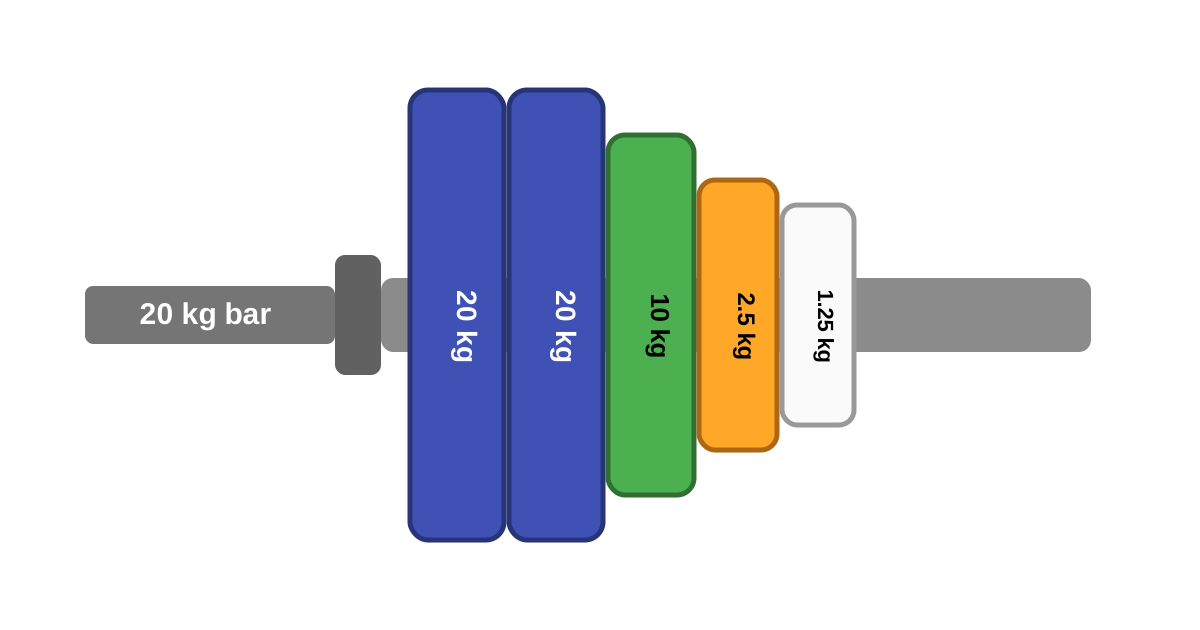
- Drop back into the rep range at the new weight and repeat. GymEvo's weight plate calculator works out the plates for each side once you know your target weight, so a small, exact increase is easy to load correctly. The progressive overload calculator runs this same rule forward for several weeks if you want to see the shape of it first.
Worked example
Here's a barbell bench press example: a 6 to 12 rep range, three working sets, starting at 60 kg.
| Session | Set 1 | Set 2 | Set 3 | Action |
|---|---|---|---|---|
| 1 | 60 kg x 6 | 60 kg x 6 | 60 kg x 6 | Keep the load and build reps when able |
| 2 | 60 kg x 7 | 60 kg x 6 | 60 kg x 6 | Total repetitions increased from 18 to 19 |
| Later | ... | ... | ... | Continue recording actual performance |
| Top of range | 60 kg x 12 | 60 kg x 12 | 60 kg x 12 | All sets reached the top: increase the load |
| Next session | 62.5 kg x 10 | 62.5 kg x 9 | 62.5 kg x 8 | Stay at 62.5 kg and build reps again |
This example uses a 2.5 kg jump because it's a common loadable increment. Reps after a load increase aren't predetermined. Record what you actually complete instead of forcing every set back to the bottom of the range. GymEvo's plate calculator can help you land on a target your plates can actually produce.
Common mistakes
- Adding weight after only one set improves. Wait until every working set reaches the top of the range, not just the first good set.
- Choosing a range that doesn't suit the lift or goal. A 1 to 5 range spans very different intensities and can be awkward for a single double-progression cycle. A tighter range, like 4 to 6, usually works better for strength-focused lifts.
- Letting technique or range of motion shrink to grind out a rep. Count reps against a consistent technical standard. A rep can slow down as fatigue builds and still count, but deliberately shortening the range of motion or changing your technique to force it through makes the comparison less useful.
- Picking weight increases you can't actually load. An awkward jump like 1.3 kg is hard to set up consistently. Round to a combination of plates you actually have.
- Not writing sessions down. Without a record of last session's reps and weight, it's easy to misremember whether you actually hit the top of the range. A notebook works, and so does an app that shows your previous sets while you track your progression in the GymEvo app.
Limits and when to move on
Double progression is a bookkeeping method for applying progressive overload, not a guarantee that a lift keeps improving forever. If progress stalls for several weeks, check your training dose, exercise selection, recovery, and whether your load jumps are practical before you overhaul the whole program.
It also suits one goal better than the other. Adding reps before weight is an efficient way to accumulate hard work, which is what drives growth; if you are chasing a maximal lift, moving the load itself matters more. Hypertrophy vs. strength covers the split.
Periodization, planned variation in load and volume, can help manage fatigue or prepare for a specific strength performance. Research shows a small strength advantage in some volume-matched comparisons, especially among trained lifters, but no consistent advantage for hypertrophy. Current ACSM guidance doesn't treat complex periodization as necessary for the average healthy adult. Periodization and when it's worth using goes through the models and the evidence.
Pain during exercise doesn't always mean you have to stop entirely. In supervised exercise for chronic musculoskeletal pain, mild discomfort can sometimes be managed rather than avoided. But stop a set for sudden or severe pain. If pain is getting worse, changing how you move, or sticking around, reduce the load or range of motion, switch to a tolerable variation, and get it checked by a qualified healthcare professional.
Sources
- Progression Models in Resistance Training for Healthy Adults — Medicine & Science in Sports & Exercise (American College of Sports Medicine) (accessed 2026-09-03)
- Resistance Training Prescription for Muscle Function, Hypertrophy, and Physical Performance in Healthy Adults: An Overview of Reviews — Medicine & Science in Sports & Exercise (American College of Sports Medicine) (accessed 2026-09-03)
- Progressive overload without progressing load? The effects of load or repetition progression on muscular adaptations — PeerJ (accessed 2026-09-03)
- Influence of resistance training load on measures of skeletal muscle hypertrophy and improvements in maximal strength and neuromuscular task performance: A systematic review and meta-analysis — Journal of Sports Sciences (accessed 2026-09-03)
- Novice, Intermediate, and Advanced Strength Training — Barbell Medicine (accessed 2026-09-03)
- Effects of Periodization on Strength and Muscle Hypertrophy in Volume-Equated Resistance Training Programs: A Systematic Review and Meta-analysis — Sports Medicine (accessed 2026-09-03)
- Should exercises be painful in the management of chronic musculoskeletal pain? A systematic review and meta-analysis — British Journal of Sports Medicine (accessed 2026-09-03)
Keep reading

Ready to evolve your training?
Download GymEvo and keep your workouts, nutrition, and progress in one place.