
RPE Calculator: Work Out Today's Training Weights
This RPE calculator turns a set you have already done into working weights for today. Enter the weight, the reps, the RPE it felt like and the RPE you want to train at, and it returns a weight for every rep count from 1 to 10, plus the estimated one-rep max behind them.
By Jobri Fitness
Use a recent working set you remember clearly. RPE 8 means you had two reps left, RPE 10 means none.
Estimated 1RM
120
kg
What to lift
| Reps | Weight | % of 1RM |
|---|---|---|
| 1 | 113.3 kg | 94.4% |
| 2 | 110 kg | 91.7% |
| 3 | 106.7 kg | 88.9% |
| 4 | 103.3 kg | 86.1% |
| 5 | 100 kgyour set | 83.3% |
| 6 | 96.7 kg | 80.5% |
| 7 | 93.3 kg | 77.8% |
| 8 | 90 kg | 75% |
| 9 | 86.7 kg | 72.2% |
| 10 | 83.3 kg | 69.4% |
Based on 100 kg for 5 reps at RPE 8, here is what RPE 8 looks like across rep counts.
Your RPE call is a judgment, and people tend to have about one more rep left than they think. Treat each weight as the middle of a range, and adjust on the day.
These are starting points from one formula, not prescriptions. Round to what you can actually load, and let the set itself have the final say.
RPE chart: percentage of 1RM by reps and RPE
Each cell is the percentage of your one-rep max (1RM) that a set of that many reps represents at that RPE. It is the same relationship the RPE calculator above uses, so multiplying your estimated max by a cell gives the working weight the calculator would return.
| Reps | RPE 10 (0 RIR) | RPE 9 (1 RIR) | RPE 8 (2 RIR) | RPE 7 (3 RIR) | RPE 6 (4 RIR) |
|---|---|---|---|---|---|
| 1 | 100.0% | 97.2% | 94.4% | 91.7% | 88.9% |
| 2 | 97.2% | 94.4% | 91.7% | 88.9% | 86.1% |
| 3 | 94.4% | 91.7% | 88.9% | 86.1% | 83.3% |
| 4 | 91.7% | 88.9% | 86.1% | 83.3% | 80.5% |
| 5 | 88.9% | 86.1% | 83.3% | 80.5% | 77.8% |
| 6 | 86.1% | 83.3% | 80.5% | 77.8% | 75.0% |
| 7 | 83.3% | 80.5% | 77.8% | 75.0% | 72.2% |
| 8 | 80.5% | 77.8% | 75.0% | 72.2% | 69.4% |
| 9 | 77.8% | 75.0% | 72.2% | 69.4% | |
| 10 | 75.0% | 72.2% | 69.4% |
One step across the chart is one rep in reserve, worth about 2.8 percentage points. The blank cells would be more than 12 reps from failure, which the calculator does not estimate.
How to use the RPE calculator
- Choose kilograms or pounds.
- Enter a working set you did recently and remember clearly: the weight lifted and the reps you completed.
- Enter the RPE that set felt like. RPE stands for Rating of Perceived Exertion, and in lifting it is counted in Reps In Reserve (RIR): RPE 8 means two reps left, RPE 9 one, RPE 10 none. It measures proximity to failure, not how tired you feel. The RPE scale describes each number.
- Enter the RPE you want to train at today.
The calculator returns a weight for every rep count from 1 to 10 at the target RPE, and the estimated one-rep max it derived them from. If you set the target RPE to match your reference set, your own weight reappears at your own rep count, which is the arithmetic checking itself.
To go the other way, from a set you already did to the percentage of 1RM it was worth, use the RPE to percentage calculator. It runs the same formula backwards.
What the inputs and outputs mean
| Field | Unit | Range | What it is |
|---|---|---|---|
| Weight lifted | kg or lb | Above 0, up to 2,000 | The load on your reference set |
| Reps completed | whole reps | 1 to 12 | What you actually did on it |
| RPE of that set | 1 to 10 scale | 6 to 10 | How close to failure it was |
| RPE you want to train at | 1 to 10 scale | 6 to 10 | The effort you are aiming for today |
| Estimated 1RM | kg or lb | Calculated | The max implied by your reference set |
| Weight | kg or lb | Calculated | What to lift for that rep count at the target RPE |
| % of 1RM | percent | Calculated | Where that weight sits relative to the estimated max |
RPE is taken in whole numbers, because half points are a programming convention rather than a research finding and sit inside the noise of an effort estimate. Reps plus reps in reserve cannot exceed 12: past roughly a dozen reps to failure the equation stops being dependable, and a number the tool cannot stand behind is worse than no number.
The formula
The RPE calculator first converts effort into reps. A set of 5 at RPE 8 is the same effort as 7 reps taken to failure:
reps to failure = reps completed + (10 - RPE)
It then estimates your max with the Brzycki equation, the same one the one-rep max calculator uses, and runs it backwards for each target rep count:
estimated 1RM = weight / (1.0278 - 0.0278 x reps to failure)
weight = estimated 1RM x (1.0278 - 0.0278 x (target reps + 10 - target RPE))
The estimated max is carried at full precision and rounded once at the end, so repeated conversions do not drift.
Worked examples: squat, bench press and deadlift
RPE-based loading is most at home on the barbell lifts of powerlifting and strength training, where a few kilograms / pounds matter and technique is stable enough to judge the reps you had left.
Squat: 100 kg / 225 lb for 5 at RPE 8
Reps to failure is 5 + (10 - 8) = 7, so the estimated max is 100 / (1.0278 - 0.0278 x 7) = 120.0 kg. Asking for RPE 8 work returns:
| Reps | Weight | % of 1RM |
|---|---|---|
| 3 | 106.7 kg | 88.9% |
| 5 | 100.0 kg | 83.3% |
| 8 | 90.0 kg | 75.0% |
| 10 | 83.3 kg | 69.4% |
Reps to failure is 5 + (10 - 8) = 7, so the estimated max is 225 / (1.0278 - 0.0278 x 7) = 270.0 lb. Asking for RPE 8 work returns:
| Reps | Weight | % of 1RM |
|---|---|---|
| 3 | 240.0 lb | 88.9% |
| 5 | 225.0 lb | 83.3% |
| 8 | 202.5 lb | 75.0% |
| 10 | 187.5 lb | 69.4% |
Five reps comes back at 100 kg / 225 lb, the set you entered. Ask for RPE 7 instead and every weight drops by about one rep's worth.
Bench press: 80 kg / 175 lb for 6 at RPE 8, triples at RPE 9
Reps to failure is 8, so the estimated bench press max is 80 / 0.8054 = 99.3 kg. A triple at RPE 9 is 4 reps to failure, or 91.7%, which gives 91.0 kg. On standard plates that means 90 kg. Back-off sets of 8 at RPE 8 on the same bench press come back at 74.5 kg.
Reps to failure is 8, so the estimated bench press max is 175 / 0.8054 = 217.3 lb. A triple at RPE 9 is 4 reps to failure, or 91.7%, which gives 199.2 lb. On standard plates that means 200 lb. Back-off sets of 8 at RPE 8 on the same bench press come back at 162.9 lb.
Deadlift: 180 kg / 405 lb for 3 at RPE 9, fives at RPE 8
Reps to failure is 4, so the estimated deadlift max is 180 / 0.9166 = 196.4 kg. Five reps at RPE 8 is 7 reps to failure, or 83.3%, which gives 163.6 kg. Load 162.5 kg and let the first set tell you whether it really was an RPE 8.
Reps to failure is 4, so the estimated deadlift max is 405 / 0.9166 = 441.9 lb. Five reps at RPE 8 is 7 reps to failure, or 83.3%, which gives 368.1 lb. Load 365 lb and let the first set tell you whether it really was an RPE 8.
Why prescribe load by RPE
Percentage-based training assumes you are the same lifter every session. Sleep, stress and accumulated fatigue change your daily readiness, so the same training load can be RPE 7 on Monday and RPE 9 on Friday. Setting today's weight from a recent set and a target RPE keeps the effort constant while the load moves with you, which is the basic idea of autoregulation.
The 1 to 10 lifting scale was popularised in powerlifting coaching by Mike Tuchscherer of Reactive Training Systems. Zourdos et al. (2016) tested it as a Reps In Reserve-based scale and found bar speed tracked the ratings closely in both novice and experienced squatters. That makes bar speed a useful second opinion, and velocity-based training measures it directly instead of asking you to judge it. It is a different instrument from the Borg scale, the original rate of perceived exertion scale, which runs 6 to 20 and rates whole-body exertion. How to measure training intensity compares RPE, RIR and percentage of 1RM in more detail.
Assumptions and limitations
- The output is only as good as your RPE call. Research pooling a dozen studies found people underestimate what they have left by about one rep on average, and that the estimate does not improve with training experience. One rep is roughly 2.8 percentage points here, so a misjudged RPE moves every weight in the table.
- It is one formula's estimate, not a measured max. Different equations disagree about the same set, and the one-rep max calculator's three formulas return different numbers.
- Long sets are the weakest case. Both the equation and your own judgment are least reliable above about 10 reps to failure, which is why the table stops where it does.
- It assumes one exercise and consistent technique. An estimate from your squat says nothing about your bench press, and a rep you would not count is not a rep the formula should count either.
- It cannot tell you whether a weight is appropriate or safe for you. If something hurts, or an injury or medical condition could change the answer, ask a qualified professional rather than a calculator.
What to do with the numbers
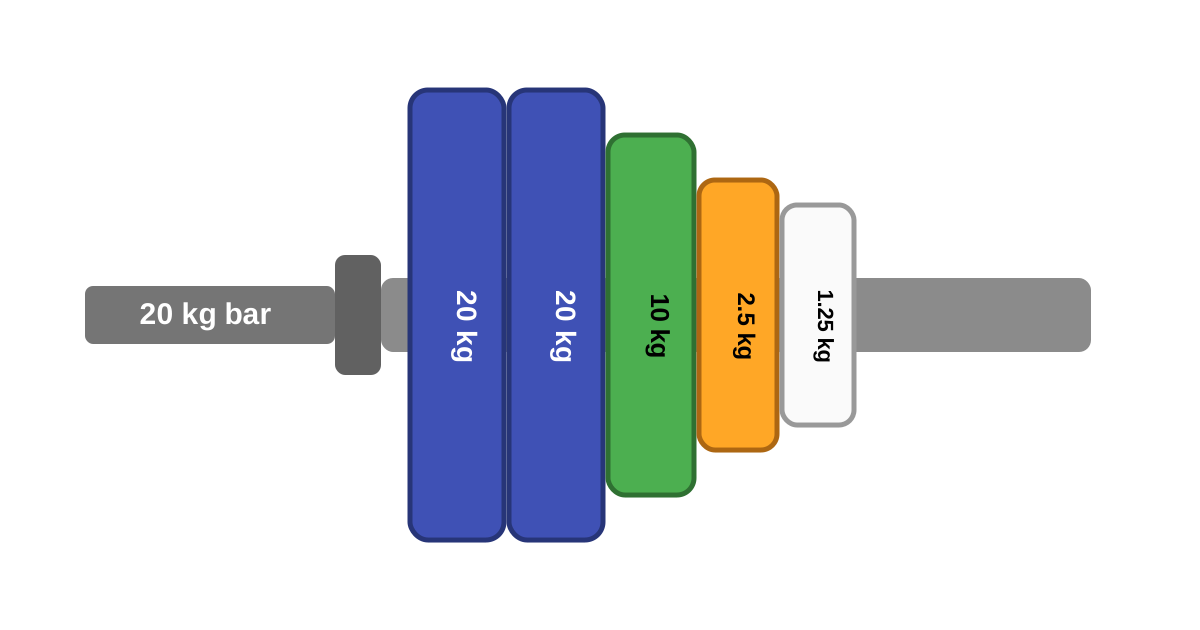
Treat each weight as the middle of a range of a couple of percent either side, then round to what you can load. The weight plate calculator shows whether 93.3 kg / 202.5 lb is something your bar and plates can make, which it usually is not; 92.5 kg / 200 lb is close enough.
Then let the set have the final say. If the prescribed weight comes in at RPE 6, the estimate was low and the next set goes up. That is the calculator doing its job: giving you a defensible starting point so the session decides the rest.
Frequently asked questions
What does RPE 7 feel like?
RPE 7 means about three reps left in reserve. The bar speed is still fast, every rep feels controlled, and the set is clearly work but well short of maximum effort. It suits early sets, volume work and technique practice on the main lifts.
How do I explain RPE to a beginner?
After the set, count the reps you could still have done with the same technique, then subtract that from 10. Two reps left is RPE 8. Most lifters guess low, beginners included, so taking an occasional set close to failure on a safe exercise is the quickest way to calibrate. How close to failure to train covers when that is worth doing.
Which RPE should I use for hypertrophy or strength?
Most productive working sets land between RPE 7 and 9 for either goal. Hypertrophy works across a wide range of loads as long as sets end reasonably close to failure, while maximal strength responds best to heavy loads, such as sets of 3 to 5 at RPE 8 to 9 on the main lifts. Hypertrophy vs. strength covers what else changes between the two.
Recording effort, not just weight
The estimate is only as current as the set you fed it. A reference set from two months ago describes the lifter you were two months ago.
GymEvo stores an RPE value alongside weight and reps on every set, shows last session's numbers on the set you are about to log, and keeps an estimated one-rep max across your whole history, so the reference set is always your most recent one rather than the one you happen to remember. Automatic progression can raise the load for you once a set comes in easy, and is part of GymEvo Premium with a 7-day free trial. See how the GymEvo app handles progressive overload.
Sources
- Strength Testing: Predicting a One-Rep Max from Reps-to-Fatigue, Journal of Physical Education, Recreation & Dance (accessed 2026-09-05)
- The Reliability and Validity of Predicting Maximal Strength, Journal of Strength and Conditioning Research (accessed 2026-09-05)
- Accuracy in Predicting Repetitions to Task Failure in Resistance Exercise: A Scoping Review and Exploratory Meta-analysis, Sports Medicine (accessed 2026-09-05)
- Novel Resistance Training-Specific Rating of Perceived Exertion Scale Measuring Repetitions in Reserve, Journal of Strength and Conditioning Research (accessed 2026-09-05)
- Psychophysical bases of perceived exertion, Medicine & Science in Sports & Exercise (accessed 2026-09-05)
- American College of Sports Medicine Position Stand. Resistance Training Prescription for Muscle Function, Hypertrophy, and Physical Performance in Healthy Adults: An Overview of Reviews, Medicine & Science in Sports & Exercise (American College of Sports Medicine) (accessed 2026-09-05)
- Resistance Training Load Effects on Muscle Hypertrophy and Strength Gain: Systematic Review and Network Meta-analysis, Medicine & Science in Sports & Exercise (accessed 2026-09-05)
- GymEvo on the App Store, Apple App Store (accessed 2026-09-07)
- GymEvo on Google Play, Google Play (accessed 2026-09-07)
Keep reading


Start tracking your training
Download GymEvo and keep your workouts, nutrition, and progress in one place.