
Autoregulation: How to Adjust Your Training to the Day
Autoregulation means letting how today's sets actually go decide today's weights, inside a plan you still follow. It builds about as much strength as a fixed plan, and its real benefit is practical: bad days stop turning into grinders and good days stop being wasted.
7 min read
The short answer
Autoregulation means adjusting today's weights, reps or sets to how you're actually performing today, instead of following a number you wrote down weeks ago. You keep the plan. You just let the load move with the day.
A fixed plan says "100 kg for 3 sets of 5." An autoregulated plan says "3 sets of 5 at a weight that leaves about two reps in the tank." On a good day that might be 102.5 kg. On a rough one, 95 kg.
It isn't a shortcut to faster gains. Autoregulated and fixed plans build about the same strength. What it does is stop a bad day from turning into a grinder and a good day from being wasted.
What autoregulation means
Autoregulation is any rule that lets your performance on the day change what you do next. It can adjust three things:
- Load: the weight on the bar goes up or down to hit a target effort.
- Reps: you do as many as the target effort allows, inside a range.
- Sets: you stop an exercise when your performance drops, instead of at a fixed number.
To make the call, you need a way to measure how hard a set was. For most lifters that's RPE, a 1 to 10 effort rating, or reps in reserve (RIR), the number of reps you could still have done. RPE 8 means about two reps left. Training intensity: RPE, RIR and percentages explains how the scales line up. Some gyms also measure bar speed, but you don't need a gadget to autoregulate.
Why a fixed plan doesn't fit every day
What you can lift moves from day to day. Sleep, stress, food, a hard shift at work and the session you did two days ago all shift it, and none of them show up in a plan written a month ago.
A fixed plan ignores that. On a bad day it asks for a weight you can't lift well, so you grind or miss reps. On a good day it asks for a weight that's too easy, so you leave progress on the table.
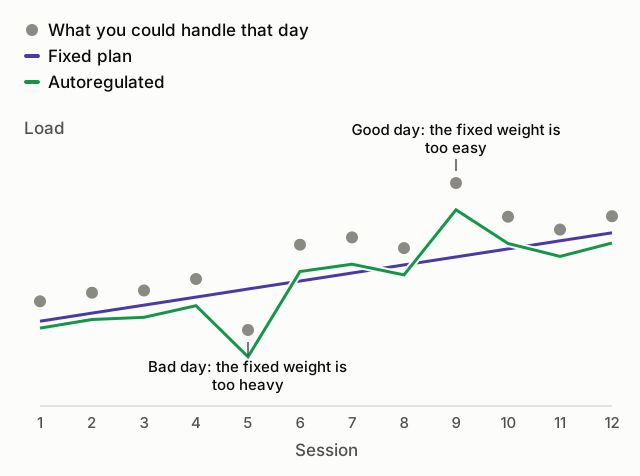 The fixed plan is right on average and wrong on the days that matter. The autoregulated load stays a couple of reps under what the day allows. Made-up data for illustration.
An autoregulated plan stays a little below what the day allows, which is the whole point. You're still training hard, just not blindly.
Does autoregulation work better?
It works about as well, which is good news for a method that's easier to live with.
A 2022 review of 15 studies found no meaningful difference in strength gains between lifters who autoregulated their loads and lifters who followed a fixed prescription. In a head-to-head trial of trained lifters, picking loads to hit a target RPE worked just as well as percentage-based loading for strength and muscle size, with a possible small strength edge for the RPE group.
So don't switch expecting a breakthrough. Switch because it handles real life better: missed sleep, a stressful week, or a day when everything feels light.
Three simple ways to autoregulate
You don't need a complicated system. These three cover most of what autoregulation is used for.
Train to a target RPE
Give each exercise a rep target and an effort target, then pick the weight that fits today.
Example: bench press, 3 sets of 5 at RPE 8.
- Warm up, then do a set of 5 at the weight you'd expect.
- If it felt like you had about two reps left, that's your working weight for today.
- If it felt like four left, add weight. If it felt like you were at your limit, take some off.
The RPE calculator helps turn a set you just did into a sensible working weight for a different RPE or rep count.
Let your reps set the weight
A rep range does a quieter version of the same job. With double progression, you keep the weight until you hit the top of the range on every set, then add weight. On a good day you get more reps, and the weight goes up sooner. On a bad day you get fewer, and it waits. Your performance decides, not the calendar.
Stop sets when performance drops
You can also let the day decide how many sets you do. This is a common coaching practice rather than a research-tested rule. Pick a target, for example sets of 8 at RPE 8, and keep going until you can no longer hit 8 reps at that effort, or until the effort for the same reps climbs a full point. On a good day you'll do more sets, on a bad day fewer. Set a sensible cap so a great day doesn't turn into a marathon.
Autoregulation and periodization aren't opposites
A common misunderstanding is that you have to choose between a plan and going by feel. You don't.
Periodization decides the shape of your training over weeks: when volume goes up, when you train heavier, when you back off. Autoregulation decides the exact weight inside each session. The plan says "this week is 4 sets of 6 at RPE 8." The day decides whether that's 97.5 kg or 102.5 kg.
That combination also makes planned lighter weeks easier to judge. A deload is still worth planning ahead. The difference is that you can see it coming when your effort ratings keep creeping up at the same weights.
The catch: effort ratings are fuzzy
Autoregulation only works if your effort ratings are roughly honest, and they're less precise than they feel.
A review of how well people predict their reps left found that lifters tend to underestimate how many reps they have remaining, by about one rep on average. The guesses get better closer to failure and on later sets, but training experience alone doesn't fix them.
Three habits keep your numbers useful:
- Read RPE as a range, not a point. "About 8" is honest. Arguing about 8 versus 8.5 isn't.
- Check yourself now and then. On a safe exercise, like a machine or a leg press, take a set to true failure occasionally and see how far off your guess was. Training to failure covers when that's worth it.
- Log it. An RPE you wrote down is data. An RPE you remember is a guess.
The other trap runs the opposite way: using "I'm not feeling it" too often. If a tired rating shows up every other session, the problem is sleep, food or overall training load, not today's weight. Why your lifts stopped progressing works through those causes.
How GymEvo handles autoregulation
GymEvo builds autoregulation into your workouts, so the adjusting happens for you instead of in your head.
It starts with how you feel. Before a workout, GymEvo asks how you're feeling. On a great day your targets aim a little higher. On a tired day they aim to hold what you did last time rather than push for more.
It follows how your sets go. Your targets aren't fixed once the workout starts. Beat a target and the sets that follow aim a little higher. Fall short and they ease off. It's the same idea as training to a target RPE, just done automatically.
Logging RPE and running periodized plans are free in GymEvo. The automatic, self-adjusting targets are part of Premium.
See how GymEvo handles progressive overload.
Common mistakes
- Using autoregulation as permission to go easy. A target RPE of 8 still means hard. It's not "whatever feels comfortable."
- Chasing a great day into a max test. Feeling strong is a reason to add a little, not to find a new one-rep max in the middle of a training block.
- Changing the plan instead of the load. Autoregulation moves the weight inside your plan. Swapping exercises or programs every time you feel off wipes out the history you need to judge progress.
- Never checking your ratings. Without an occasional reality check, "RPE 8" slowly turns into RPE 6.
- Ignoring a pattern of bad days. One tired session is noise. Two weeks of them is a recovery problem.
Sources
- The Effect of Load and Volume Autoregulation on Muscular Strength and Hypertrophy: A Systematic Review and Meta-Analysis — Sports Medicine - Open (accessed 2026-09-22)
- RPE vs. Percentage 1RM Loading in Periodized Programs Matched for Sets and Repetitions — Frontiers in Physiology (accessed 2026-09-22)
- Accuracy in Predicting Repetitions to Task Failure in Resistance Exercise: A Scoping Review and Exploratory Meta-analysis — Sports Medicine (accessed 2026-09-05)
- Training intensity: RPE, RIR and percentages (GymEvo, the publisher's own page on effort scales) — Jobri Fitness (accessed 2026-09-22)
- GymEvo app capabilities — Jobri Fitness (accessed 2026-09-22)
- GymEvo Free vs Premium: What You Get and When to Upgrade — Jobri Fitness (accessed 2026-09-22)
Keep reading



Start tracking your training
Download GymEvo and keep your workouts, nutrition, and progress in one place.