
How Many Sets Per Week to Build Muscle
About 10 hard sets per muscle per week is a good starting point for building muscle, and more usually helps a little more, with smaller returns each time. Counting your sets honestly and adding them slowly matters more than hitting a perfect number.
By Jobri Fitness
7 min read
Updated 2026-09-22

The short answer
About 10 hard sets per muscle per week is a good starting point for building muscle. More sets usually help a little more, but each extra set adds less than the one before.
That's a reference point, not a minimum. If you're new to lifting, or you're still making progress on fewer sets, start lower and build up. If your goal is strength rather than size, sets matter less than the weight on the bar, and extra sets stop paying off sooner.
Nobody can hand you a personal number. The research gives you a direction instead: more sets, more growth, flattening out as you go. That's enough to plan with, because the useful decision each month is whether to add a set, not what your perfect number is.
Adding sets is one way to apply progressive overload. The complete guide to progressive overload compares it with adding weight or reps, and hypertrophy vs. strength explains why extra sets keep paying off for longer when size is the goal.
What the research says
Three findings are worth knowing.
Around 10 sets or more works better for growth. The 2026 position stand from the American College of Sports Medicine pulled together more than a hundred research reviews and found that muscle growth was better at about 10 or more sets per muscle per week.
The returns shrink as you add sets. A large 2026 analysis of the volume studies found that both size and strength kept improving as weekly sets went up, but each added set bought a bit less. Strength flattened out sooner than size.
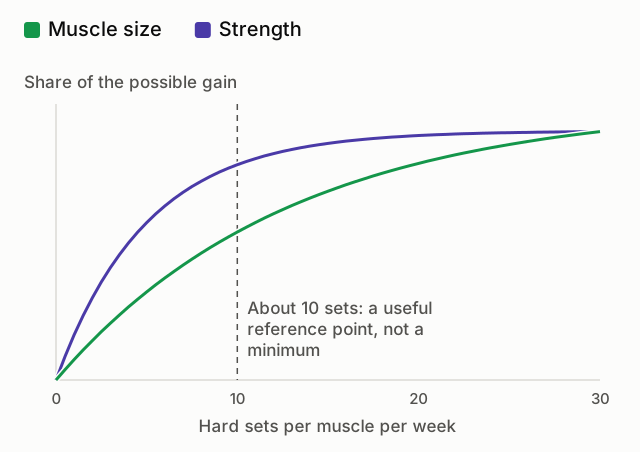 The shape of the research: more sets keep helping, with smaller returns that arrive sooner for strength. Each line is scaled to its own maximum, and the curves are not fitted to study data.
One extra set does something, but not much. An earlier analysis put a rough number on it: on average, each extra weekly set added about a third of a percent more muscle growth. That's an average across studies, not a promise for your chest. What it tells you is that volume works slowly. You add it over months, not to rescue a bad week.
How to count a set
A set counts for a muscle when that muscle does real work and you finish reasonably close to failure.
The tricky part is exercises that train more than one muscle. A barbell row is a full set for your back but only part of a set for your biceps. Count it fully for both and your weekly number looks bigger than it really is. The 2026 analysis above found that separating these direct and indirect sets mattered for predicting results.
A simple rule that works:
- Direct sets count fully. The muscle is the main target: curls for biceps, leg extensions for quads.
- Indirect sets count separately, or at a discount. The muscle helps but isn't the target: triceps on a bench press, biceps on a row. Whichever convention you pick, stick with it.
- Warm-ups don't count. Keep them out of the total.
How close to failure does a set need to be? Closer than easy, but you don't have to hit failure. A review of 15 studies found that going all the way to failure gave only a trivial advantage for growth over stopping a rep or two short. There's also no exact cut-off, like five reps in reserve, where a set suddenly stops counting. Use one consistent rule, and log reps in reserve so you can see how hard your sets actually were.
The training volume calculator keeps direct and indirect sets in separate totals, so you can see how much the overlap changes your number.
How to add sets over time
Treat extra sets like extra weight: small steps, one change at a time, and enough time to judge the result. Where those sets go in your week is a smaller decision, covered in how often to train a muscle. How hard each set should be is covered in how close to failure to train. If you don't have a routine yet, the workout plan generator builds a week and lists its sets per muscle, which gives you a starting count.
- Count what you do now. Tally your hard sets per muscle over two normal training weeks. Most people are off in one direction or the other.
- Add one or two sets a week to one muscle. Not to every exercise, and not to every muscle at once.
- Keep it for three to four weeks. The effect of more volume shows up over weeks, not sessions.
- Check your log. If your weights and reps are still climbing, the extra sets are paying off. If they've gone flat or dropped, look at recovery first and consider going back to your old volume. A flat patch on its own doesn't prove you've hit your limit.
- Add again, or hold. You don't have to keep adding. Staying at a volume that's still producing progress is a good plan.
Spreading sets out helps too. Twelve sets for a muscle split across two sessions means fewer tired sets at the end of one long workout. Expect that to help your strength more than your size.
Signs you've added too much
Sets cost recovery and gym time, so volume is the one progression variable with a real budget. These are the signs you've gone over it:
- Your main lifts stall or slip across several weeks of logged sessions.
- Sessions run so long that the last exercises get skipped or rushed. Cutting your rest between sets to fit everything in costs you reps rather than saving the session.
- Your joints stay achy from one session to the next.
- Your sleep or appetite changes noticeably.
Any one of these can just be a bad week. Two or three together, alongside a flat log, mean it's time to go back to the volume that was working.
Where the research runs out
Three limits to keep in mind before you treat any number as a rule.
Most participants were young men. In the large 2026 analysis, about four in five participants were male, with an average age of around 25. Most volume research looks like that.
The studies are short. Most run 6 to 12 weeks. That's long enough to see a difference in growth, but too short to say whether a high volume is sustainable for a whole year.
Volume is only one part of a program. The ACSM position stand found that most details of how a program is set up made little consistent difference. Training regularly and progressing over time mattered more. A program you actually run at 10 sets beats one you abandon at 20.
Keeping count
Counting hard sets per muscle by hand is tedious, and most people give up after about two weeks, which is right when the numbers would start to be useful.
GymEvo logs every set, and the free tier charts total volume and estimated one-rep max for each exercise. Premium adds weekly and monthly reviews that show which muscle groups you trained. Keep in mind that total volume (weight times reps) isn't the same thing as hard sets per muscle, so you still need to allow for exercises that overlap. See how GymEvo helps you build muscle.
If your log has gone flat and adding sets hasn't helped, the problem may be somewhere else. Why your lifts stopped progressing works through the usual causes in order.
For turning weekly set counts into exercises for a specific muscle, how to build strength and muscle, body part by body part covers each one. The glutes are the clearest case of overlapping exercises making the count misleading, and how to grow your glutes works through it.
Sources
- American College of Sports Medicine Position Stand. Resistance Training Prescription for Muscle Function, Hypertrophy, and Physical Performance in Healthy Adults: An Overview of Reviews, Medicine & Science in Sports & Exercise (American College of Sports Medicine) (accessed 2026-09-05)
- The Resistance Training Dose Response: Meta-Regressions Exploring the Effects of Weekly Volume and Frequency on Muscle Hypertrophy and Strength Gains, Sports Medicine (accessed 2026-09-05)
- Dose-response relationship between weekly resistance training volume and increases in muscle mass: A systematic review and meta-analysis, Journal of Sports Sciences (accessed 2026-09-05)
- Influence of Resistance Training Proximity-to-Failure on Skeletal Muscle Hypertrophy: A Systematic Review with Meta-analysis, Sports Medicine (accessed 2026-09-05)
- GymEvo Free vs Premium: What You Get and When to Upgrade, Jobri Fitness (accessed 2026-09-22)
- GymEvo app capabilities, Jobri Fitness (accessed 2026-09-22)
Keep reading






Start tracking your training
Download GymEvo and keep your workouts, nutrition, and progress in one place.