
How to Grow Your Glutes: Exercises, Sets and a 3-Day Plan
The glutes grow from loaded hip extension, and most programs only give them one version of it. This guide covers what the muscle does, which exercises cover which part of the range, how many weekly sets to run, a 3-day glute program with a 12-week progression, and the home version.
11 min read
The short answer
How to grow your glutes: load hip extension hard, from both ends of the range, two to three times a week, for 10 to 20 hard sets. Hip thrusts and squats both work. Doing only one of them is the usual reason glutes stall.
The glutes are one of the easier muscles to train well, because the exercises are simple and the loads climb fast. They are also one of the easiest to train badly, because "squats and lunges" feels like enough and usually is not.
What the glutes actually do
Three muscles, one main job and two side jobs.
- Gluteus maximus is the big one. It extends the hip: it drives your torso upright from a bent-forward position and drives your hip forward at the top. Nearly everything you feel as glute training is this muscle.
- Gluteus medius and minimus sit higher and further to the side. They pull the leg out to the side and stabilise the pelvis when you stand on one leg. They add the width at the top of the hip.
That split matters for exercise choice. Hip extension under load grows the gluteus maximus and you cannot really avoid training it if you squat or hinge at all. The medius and minimus get some work from single-leg exercises and almost nothing from bilateral ones, which is why abduction work is worth a few sets rather than none.
The part most programs miss
Hip extension happens across a range, and exercises load different parts of it.
- Stretched, hip fully bent: deep squats, Romanian deadlifts, lunges at the bottom. The glute is long and under load.
- Shortened, hip straight or past straight: the top of a hip thrust, a kickback. The glute is short and squeezing against resistance.
A squat loads the first and basically nothing of the second, because by the time you are standing upright the bar is directly over your hips and the glutes are barely resisting anything. A hip thrust is the opposite. Running both is not redundancy, it is coverage.
Two things worth knowing, without turning this into a research summary:
Depth matters more than load for the glutes. In a 10-week comparison of full squats against half squats, the deeper group's glutes grew noticeably more, even though the half-squat group handled heavier weights (Kubo et al., European Journal of Applied Physiology, 2019). Cutting depth to add plates trades away the part of the rep that was growing the muscle.
Adding hip thrusts to a leg program adds glute growth. Untrained women training leg press and stiff-leg deadlift for 10 weeks gained gluteus maximus thickness. The group that did the same thing plus barbell hip thrusts gained meaningfully more (Kassiano et al., International Journal of Strength and Conditioning, 2024).
What that does not mean is that hip thrusts beat squats. Trained head to head at matched sets, the two produce similar glute growth, and the squat additionally grows the quads and adductors (Plotkin et al., Frontiers in Physiology, 2023). Pick both.
The exercise list
All of these are in GymEvo's exercise library, with the equipment options shown.
Loaded stretch (hip bent)
| Exercise | Equipment | Notes |
|---|---|---|
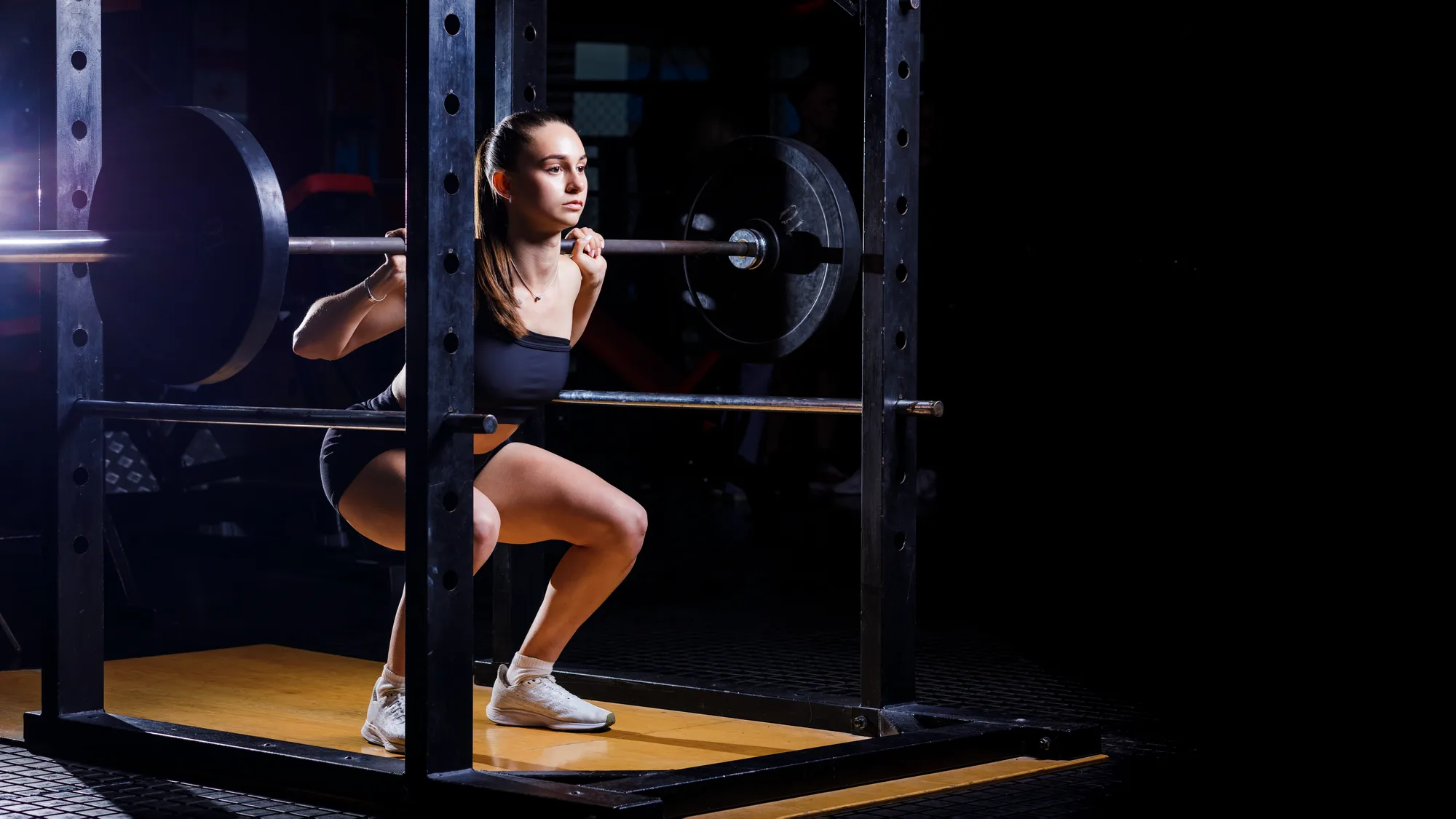
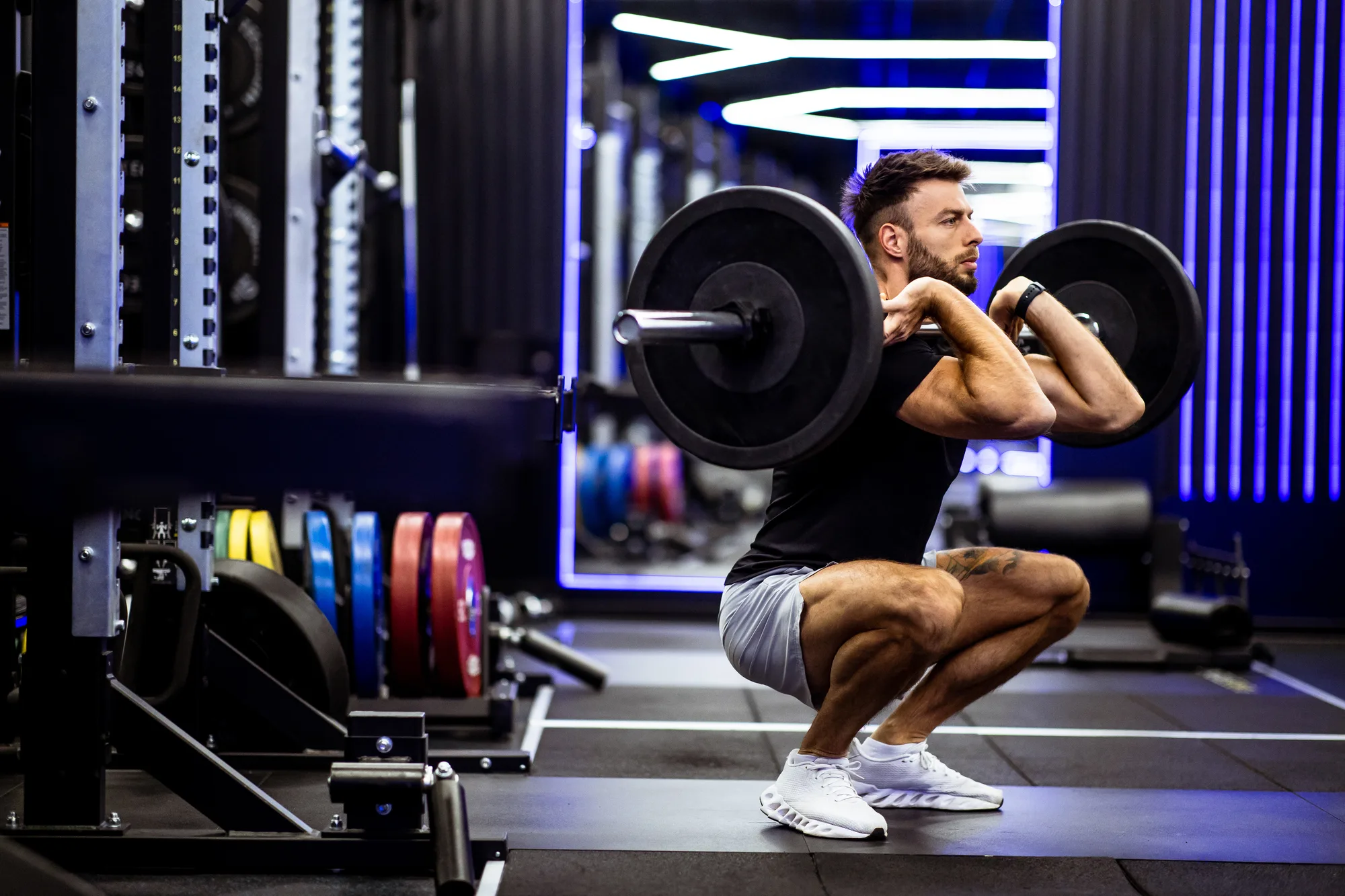
| Squat | Barbell, Smith machine, Bodyweight | Go as deep as you can control. Depth is the glute part |
| Romanian Deadlift | Barbell, Dumbbells, Smith machine | The cleanest hinge. Push the hips back, feel it in the hamstrings and glutes |
| Bulgarian Split Squat | Dumbbells, Bodyweight, Smith machine | One leg, long range, and it hits the medius as a bonus |
| Walking Lunges | Dumbbells, Bodyweight | Longer steps shift work from quads to glutes |
| Deadlift | Barbell, Dumbbells | Heaviest hip extension available, at the cost of a lot of fatigue |
| Good Morning | Barbell | Hinge with less grip and forearm load than a deadlift |
Shortened position (hip straight)
| Exercise | Equipment | Notes |
|---|---|---|
| Hip Thrust | Barbell, Machine, Bodyweight | The main one. Loads the top of the range where nothing else does |
| Glute Kickback | Cables | Single leg, easy to progress in small jumps |
| Back Extension | Bodyweight, Other weights | Round the upper back slightly and drive with the hips, not the lower back |
| Reverse Hyperextension | Machine, Bodyweight | Same idea, less lower-back involvement |
| Kettlebell Swing | Kettlebells | Fast hip extension. Conditioning with a glute bias, not a growth exercise |
Abduction (the upper, outer part)
| Exercise | Equipment | Notes |
|---|---|---|
| Hip Abduction | Machines | Two or three sets at the end of a session is enough |
| Step-Ups | Dumbbells, Bodyweight | Single-leg work that makes the medius stabilise the pelvis |
How many sets a week
Ten to twenty hard sets, same as any other muscle group, and you have to count honestly. A squat set is a glute set and a quad set. A Romanian deadlift set is a glute set and a hamstring set. Three exercises that all load the stretched position are not three different stimuli.
- Frequency: two or three sessions a week. Three lets you spread the volume so the last exercise of each session still gets real effort.
- Reps: 5 to 8 on heavy hip thrusts and squats, 8 to 12 on hinges and split squats, 12 to 20 on kickbacks and abduction.
- Effort: two to three reps in reserve on the heavy compounds, closer to failure on the machine and cable work. How close to failure to train covers where the line sits.
- Rest: two to three minutes after heavy hip thrusts and squats, 90 seconds elsewhere.
The training volume calculator counts direct and indirect sets per muscle if you want the weekly number without doing it in your head, and how many sets per week explains where the 10 to 20 range comes from.
A 3-day glute program
Three lower-body sessions a week. Each one leads with a different pattern so the heavy work on each is separated by several days. Everything else in your week stays as it is.
Day A, heavy thrust
| Exercise | Sets | Reps |
|---|---|---|
| Hip Thrust (barbell) | 4 | 6 to 8 |
| Squat | 3 | 6 to 8 |
| Hip Abduction | 2 | 15 to 20 |
Day B, hinge
| Exercise | Sets | Reps |
|---|---|---|
| Romanian Deadlift | 3 | 8 to 10 |
| Bulgarian Split Squat | 3 | 8 to 10 per leg |
| Back Extension | 2 | 12 to 15 |
Day C, volume
| Exercise | Sets | Reps |
|---|---|---|
| Hip Thrust (barbell or machine) | 3 | 12 to 15 |
| Walking Lunges | 3 | 10 per leg |
| Glute Kickback | 3 | 12 to 15 per leg |
That is roughly 16 to 19 glute sets a week once you count the squat and hinge work, which sits in the useful part of the range without being a full-time job.
The 12-week progression
| Weeks | What changes |
|---|---|
| 1 to 3 | Find your working weights at three reps in reserve. Add weight whenever you hit the top of the rep range on every set |
| 4 to 6 | Add a fourth set to the Day C hip thrust and a third to the Day A abduction. Effort moves to two reps in reserve |
| 7 to 9 | Volume holds. Take the last set of each hip thrust to one rep in reserve, and keep adding load where the reps allow |
| 10 | Deload. Half the sets, same weights, nothing near failure |
| 11 to 12 | Restart the sequence at the loads you finished week 9 on. If the hip thrust has not moved in six weeks, the problem is calories or sleep, not the program |
Increments: 5 kg on hip thrusts and squats while that keeps working, 2.5 kg once it does not. How much weight to add and when covers what to do when the jumps get too big to make.
How fast can glutes actually grow?
Faster than most muscles in terms of strength, slower than anyone wants in terms of size.
Your hip thrust will climb quickly in the first couple of months, partly because you are getting better at the movement and partly because it is a short-range lift with a lot of muscle behind it. Doubling your working weight in twelve weeks is normal and does not mean your glutes doubled.
Visible size takes months. In the hip thrust study above, ten weeks of consistent training moved gluteus maximus thickness by roughly 6 to 9 percent in untrained women, measured by ultrasound. That is a real change, and it is not something you would spot in a mirror from week to week. How long until you see results from lifting sets the timeline properly.
The honest version of "how to grow glutes fast": there is no faster method, only fewer wasted weeks. The things that waste weeks are training two days a week instead of three, never adding weight, cutting squat depth, skipping the shortened-position work, and eating at maintenance. Fix those and you are already going as fast as the muscle does. If you are eating to grow, how to bulk up without getting fat covers the size of the surplus.
Bigger glutes and a bigger butt are not quite the same question
Worth separating, because a lot of training frustration comes from confusing them.
Shape at the hip comes from three things: how much gluteal muscle you have, how much body fat sits over and around it, and your pelvic and femur structure. Training changes the first. Diet changes the second, and not selectively: you cannot choose where fat leaves or arrives. The third does not change at all.
So the training answer to "how to build a bigger butt" is the same as the training answer to growing the muscle, and the rest is body composition and genetics. If you are in a deficit, expect the glutes to get firmer and rounder rather than bigger, and hold your lifts steady while you are there.
Glutes at home
Better than most muscle groups without a gym, because hip extension scales well to one leg and bodyweight is a meaningful load in a split stance.
From GymEvo's library with no equipment: Hip Thrust, Bulgarian Split Squat, Walking Lunges, Forward Lunge, Step-Ups, Squat, Paused Squat, Pistol Squat, Back Extension, Reverse Hyperextension.
Two that carry a home program:
- Single-leg hip thrusts, shoulders on a sofa or bed, one foot down, the other leg held up. Pause a full second at the top. This is the only bodyweight exercise that loads the shortened position properly.
- Bulgarian split squats, rear foot on a chair. One leg under most of your bodyweight through a long range is close enough to real training that it works on its own.
Progress by reps first, then a harder single-leg version, then a loaded backpack, then pauses and slower lowering. Progressive overload with bodyweight and calisthenics covers the order to apply those in.
What to track
The hip thrust is the single best number to watch here, because it moves in clean increments and it is almost pure glute. If it is climbing, the program is working. If it has been flat for six weeks, nothing about your exercise selection is the problem.
GymEvo's free tier logs weight, reps and RPE on every set, shows you last session's numbers on the set you are about to do, and charts estimated one-rep max and total volume per exercise across your whole history. For a 12-week block like the one above, that chart is the answer to "is this working", and it takes about four seconds per set to produce. See how GymEvo handles progressive overload, or use the free workout plan generator if you want the three days above fitted into a full weekly split.
Common mistakes
- Only squatting. Covers the stretched position, leaves the top of the range untrained.
- Only hip thrusting. The reverse problem, and you give up the quad and adductor growth that comes free with squats.
- Cutting squat depth to add weight. Trades the part of the rep that grows the glutes for a bigger number.
- Hip thrusts with no pause and a bouncing hip. Pause at the top, ribs down, hips fully straight. Half the people loading four plates are throwing it up with their lower back.
- Endless banded warm-up work counted as training. Activation work is fine. It is not three of your weekly sets.
- Two sessions a week with everything crammed into one leg day. Twenty sets in a single session means the last eight are junk.
- Expecting mirror feedback weekly. Track the hip thrust load. That moves in weeks. The mirror moves in months.
Heavy hip thrusts and squats are lifts where form breaking down under fatigue actually hurts people, usually the lower back. Learn both patterns at a light weight before chasing the progression table, and end a set when your technique changes rather than when the reps run out. This page is general training education, not individual medical advice. For the rest of the leg, how to get bigger legs covers quads, hamstrings and calves, and how to build strength and muscle body part by body part is the hub for every other muscle group.
Sources
- Effects of squat training with different depths on lower limb muscle volumes — European Journal of Applied Physiology (accessed 2026-09-20)
- Research Spotlight: Effects of squat depth on muscle growth — Stronger By Science (accessed 2026-09-20)
- Addition of The Barbell Hip Thrust Elicits Greater Increases in Gluteus Maximus Muscle Thickness in Untrained Young Women — International Journal of Strength and Conditioning (accessed 2026-09-20)
- Hip thrust and back squat training elicit similar gluteus muscle hypertrophy and transfer similarly to the deadlift — Frontiers in Physiology (accessed 2026-09-20)
- GymEvo exercise catalog (repository mirror of the app's public exercise library) — GymEvo (accessed 2026-09-20)
- GymEvo Free vs Premium: What You Get and When to Upgrade — GymEvo (accessed 2026-09-20)
Keep reading

Start tracking your training
Download GymEvo and keep your workouts, nutrition, and progress in one place.