Cable Woodchop
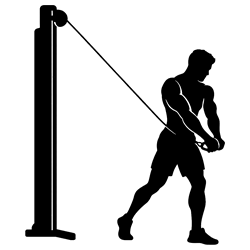
Standing side-on to a high cable, you pull the handle down and across your body toward the opposite hip with nearly straight arms, rotating through your torso.
- Primary muscles
- Obliques, Abs
- Secondary
- Front delts
- Difficulty
- Beginner
- Logged as
- Weight × reps
Loads from YouTube only when you press play. The video is by an independent creator.
Why do it
The woodchop trains rotation under load, the opposite of the Pallof press, which trains you to resist it. That makes it popular with people who play throwing, racket or contact sports, and with anyone who wants oblique work done standing up. The cable keeps tension through the whole arc and lets you add load in small steps. Set the pulley low and chop upward to load your obliques from the other direction, or set it at chest height for a horizontal chop.
How to do it
Set a single handle at the top of the pulley, stand side-on and grab it with both hands above the shoulder nearest the machine.
With your arms nearly straight, pull the handle down and across your body toward the opposite hip.
Rotate from your torso and let your back foot pivot, keeping your arms as a fixed lever.
Return slowly along the same path, then switch sides. Set the pulley low and chop upward for the reverse version, which loads the obliques from the opposite direction.
Common mistakes
Pulling with your arms
Bending your elbows turns it into a cable pull for your arms and shoulders. Keep your arms nearly straight and let your torso turn the handle across.
Keeping your back foot planted
If your back foot stays put, your hips can't turn and the rotation gets cramped. Let your back heel lift and pivot as you rotate.
Letting the stack yank you back
Heaving the handle down and letting the weight snap you back loses half the work. Return along the same path at least as slowly as you chopped.
Sets, reps and progression
How many sets you do and how close to failure you take them depend on your goal and your week, not on the exercise. These guides cover it:
Alternatives that train the same thing
Same movement, a different angle or piece of equipment.