Rower
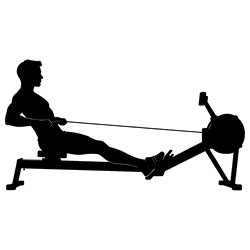
Rowing on an ergometer: each stroke starts with a leg drive, then a slight lean back, then an arm pull to your lower ribs, working legs and back together.
- Primary muscles
- Lats, Quads, Glutes
- Secondary
- Upper back, Hamstrings, Biceps, Abs
- Logged as
- Session: time, plus what the machine shows, such as distance and calories
Loads from YouTube only when you press play. The video is by an independent creator.
Why do it
The rower trains your legs, hips and back together with no impact, which is why it's a staple for conditioning. Technique matters more than on most cardio machines: the power comes from your legs, not your arms, and the order reverses on the way back. A damper around 3 to 5 suits most people; a higher setting feels heavier but doesn't make the workout better. Your split, the time per 500 meters, is the standard number to compare rows by.
How to do it
Strap your feet in so the strap crosses the widest part of the foot and set the damper around 3 to 5; a higher damper makes each stroke heavier, not the workout better.
Start each stroke with your legs: push back with straight arms, swing your torso slightly back, then pull the handle to your lower ribs.
Return in reverse order, arms away first, then lean forward, then bend your knees, with a quick drive and a slower recovery.
Row easy for the last minutes. Log damper and stroke rate as they change and copy distance, split per 500 m and watts from the display at the end.
Common mistakes
Pulling with the arms first
Starting the stroke with your arms wastes your strongest muscles. Push with your legs, then lean back, then pull.
Damper too high
A heavy damper feels like a harder workout but mostly tires your back and arms. Most people do best around 3 to 5.
Rushing the recovery
Sliding forward fast breaks your rhythm. Drive quickly and return slowly: arms, then body, then knees.
Rounding your back
Keep your chest up and your back straight at the catch; hunching forward loads your lower back.
Sets, reps and progression
How many sets you do and how close to failure you take them depend on your goal and your week, not on the exercise. These guides cover it:
Alternatives that train the same thing
Same movement, a different angle or piece of equipment.