Side Plank
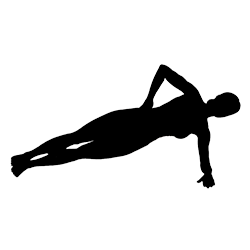
A sideways hold on one forearm: you lift your hips until your body forms a straight line and keep it there, mostly working your obliques.
- Primary muscles
- Obliques
- Secondary
- Lower back, Abs, Adductors
- Difficulty
- Beginner
- Logged as
- Time
Loads from YouTube only when you press play. The video is by an independent creator.
Why do it
The side plank trains your core to resist bending sideways, which a regular plank barely asks of it. It needs no equipment and scales easily: drop to your bottom knee to make it easier, or raise your top leg to make it harder. Because you hold one side at a time, it quickly shows whether one side is weaker than the other. It fits well at the end of a workout or as part of a warm-up before heavy lifting.
How to do it
Lie on your side with your legs stacked and your bottom elbow directly under your shoulder, forearm flat on the floor.
Lift your hips until your body forms a straight line from head to feet.
Hold, keeping your hips up and your torso square rather than rolling forward or back.
Lower under control and repeat on the other side. Drop to your bottom knee if you can't hold the line for the full time yet.
Common mistakes
Letting your hips sag toward the floor
Once your hips drop, you're hanging on your shoulder and the obliques switch off. Keep pushing the bottom hip up; if it keeps sinking, shorten the hold or drop to your knee.
Rolling your chest toward the floor
Your torso tips forward and the hold turns into a twisted plank. Stack your shoulders and hips on top of each other, as if your back were against a wall.
Elbow drifting away from the shoulder
With the elbow out in front or too far to the side, the shoulder takes the strain and the line falls apart. Set it directly under your shoulder before you lift.
Holding your breath through the set
Bracing doesn't mean not breathing. Take short, steady breaths through the hold; if you can only last by holding your breath, the hold is too long for now.
Sets, reps and progression
How many sets you do and how close to failure you take them depend on your goal and your week, not on the exercise. These guides cover it:
Alternatives that train the same thing
Same movement, a different angle or piece of equipment.