Sled Push
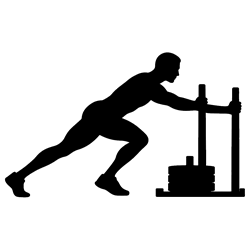
Driving a loaded sled forward along a lane with short, powerful steps, leaning in with locked arms so your legs do the work.
- Primary muscles
- Quads, Glutes
- Secondary
- Calves, Hamstrings, Triceps, Middle chest
- Logged as
- Session: time, plus what the machine shows, such as distance and calories
Loads from YouTube only when you press play. The video is by an independent creator.
Why do it
The sled push is one of the most direct ways to train leg drive and conditioning: there's no lowering phase and little technique beyond a good lean. A heavy sled makes it a strength effort, a lighter one sprint conditioning. Because the load and lane length are fixed, progress is easy to measure: the same lengths with a heavier sled. The floor changes how heavy a given load feels, so compare sessions on the same lane.
How to do it
Load the sled, enter the load and the length of your lane, then grip the upright poles at chest height or lower and lean in until your body forms a straight line from head to rear heel.
Drive the sled forward with short, powerful steps, pushing through the balls of your feet.
Keep your arms locked, your back flat and your hips low; do not let your hips rise above your shoulders.
Tap once for every length you finish. A heavier sled for the same lengths counts as progress.
Common mistakes
Letting the hips rise
When your hips climb above your shoulders, your back takes over. Keep your hips low and your body in a straight line.
Standing too upright
An upright stance pushes the sled into the floor instead of forward. Lean in until your body forms a line from head to rear heel.
Bending the arms
Bent elbows soak up force. Lock your arms so the drive from your legs goes into the sled.
Sets, reps and progression
How many sets you do and how close to failure you take them depend on your goal and your week, not on the exercise. These guides cover it:
Alternatives that train the same thing
Same movement, a different angle or piece of equipment.