Upright Bike
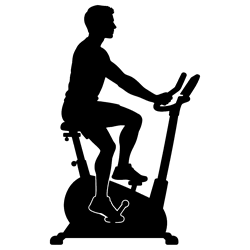
Pedaling a stationary bike in an upright seated position at a steady cadence, mainly working your quads.
- Primary muscles
- Quads
- Secondary
- Glutes, Hamstrings, Calves
- Logged as
- Session: time, plus what the machine shows, such as distance and calories
Why do it
The upright bike is the everyday gym bike: easy to adjust, low impact and good for anything from warm-ups to long steady sessions. It's easy on the knees when the saddle is set right, which is the one thing worth taking a minute for. A steady cadence of about 80 to 90 per minute at a level you have to work for is a good default, and a higher level for the same time is progress you can see in your log.
How to do it
Set the saddle so your knee stays slightly bent with the pedal at the bottom, and tighten the foot straps if the pedals have them.
Ride a few minutes on a low level, then raise it to a level at which you can still hold a steady cadence of about 80 to 90 per minute.
Sit tall with relaxed shoulders, keep your knees in line with your feet and push through the whole pedal stroke.
Lower the level for the last minutes. Log level and cadence as they change, and copy distance, watts and calories from the display at the end.
Common mistakes
Saddle too low
A low saddle bends your knee sharply on every stroke. Set it so the knee stays slightly bent with the pedal at the bottom.
Knees caving in
Keep your knees tracking in line with your feet.
Hips rocking side to side
If your hips rock, the saddle is too high. Lower it until you pedal smoothly.
Sets, reps and progression
How many sets you do and how close to failure you take them depend on your goal and your week, not on the exercise. These guides cover it:
Alternatives that train the same thing
Same movement, a different angle or piece of equipment.