
How to Build Chest Muscles: Angles, Sets and Progression
The chest is built on pressing, loaded heavily and progressed for months. This guide covers which angles to run and why, where flyes fit, how many sets per week, an eight-week progression table, and what changes when your only equipment is the floor.
9 min read
The short answer
How to build chest muscles: press at two angles rather than one, add a fly or a deep dumbbell press to load the stretched position, run 10 to 20 hard sets a week across two sessions, and make the load climb over months. Pressing is the whole foundation. Everything else is shaping the edges of it.
The chest is one of the easiest muscles to train and one of the easiest to stall on, because bench press numbers plateau early and most people respond by adding exercises rather than fixing progression.
What the chest actually does
The pectoralis major pulls your upper arm across the front of your body. It has two sections that pull in slightly different directions:
- The clavicular head, the upper chest, runs from the collarbone and pulls the arm up and across.
- The sternocostal head, the larger middle and lower portion, runs from the sternum and ribs and pulls the arm down and across.
Because they pull at different angles, the angle you press at changes how the work is shared. That is the entire argument for doing more than one press.
What ten weeks of bench pressing actually grows
Worth knowing before you decide the bench press is not enough.
Twenty-four men were assigned to a ten-week bench press program or a control group, training three times a week, with muscle cross-sectional area measured by MRI. The training group grew the pectoralis major, pectoralis minor, anterior deltoid and triceps brachii more than controls. Growth was not evenly distributed: the pectoralis major gained more than the pectoralis minor and the triceps did (Lanza et al., Journal of Bodywork and Movement Therapies, 2024).
So a single pressing movement, progressed, builds a chest. The refinements below are worth doing, but they are refinements. If your bench press has not moved in a year, no fly variation is going to fix that.
Press angles
Direct comparisons of bench angles for chest hypertrophy are thin, so this rests on two weaker pieces of evidence rather than one strong one. Take it as a reasonable bet, not a settled result.
What activation studies show. Electromyography across five bench inclinations (0, 15, 30, 45 and 60 degrees) found peak upper pectoralis activity at 30 degrees, while the middle and lower portions were most active at a flat 0 degrees (Rodríguez-Ridao et al., International Journal of Environmental Research and Public Health, 2020). Activation is not growth, and studies that have tracked both do not always agree, so this is a hint about how the work is shared rather than proof of where you will grow.
What regional hypertrophy studies show elsewhere. In muscles where it has been tested directly, changing the joint position changes which part of the muscle grows. Preacher and incline curls grew opposite ends of the biceps over eight weeks (Kassiano et al., International Journal of Sports Medicine, 2025). It is reasonable to expect the chest behaves similarly.
The practical version:
- Run a flat press and an incline press across your week rather than two flat presses. A low incline, around 30 degrees, is the useful one. Steeper than 45 and the front delts take over.
- Decline is optional. The lower chest already gets heavy work from flat pressing and dips.
- Do not split hairs. The difference between angles is smaller than the difference between a chest that is progressing and one that is not.
Where flyes earn their place
A press stops loading the chest hard at the bottom, because your arms and shoulders limit how far the bar can travel. A fly keeps tension on the muscle in the stretched position, which is where the strongest recent evidence for exercise selection points. Training a muscle at long lengths has produced more growth than training it short in trials on the triceps (Maeo et al., European Journal of Sport Science, 2023) and the hamstrings (Maeo et al., Medicine and Science in Sports and Exercise, 2021).
One fly variation per week is enough. Do it with a weight you can control at the bottom, because the stretched position is the point and it is also where the shoulder is most vulnerable.
The exercise list
Every exercise below exists in GymEvo's library, with the equipment options shown in brackets.
| Exercise | Equipment | Role |
|---|---|---|
| Bench Press | barbell, dumbbell, Smith machine, cable | The main lift. Heaviest loading available |
| Incline Bench Press | barbell, dumbbell, Smith machine | Second angle. Biases the upper chest |
| Chest Press | machine | Low-skill pressing volume when you are fatigued |
| Incline Chest Press | cable, machine | Upper chest without balancing a bar |
| Dips | bodyweight, machine | Lower chest and triceps. Add load once reps are easy |
| Chest Fly | dumbbell, cable | Loads the stretched position |
| Incline Chest Fly | dumbbell | Same, biased upper |
| Decline Bench Press | barbell, dumbbell | Optional. Lower chest emphasis |
A complete week is two presses and one fly, repeated twice. Adding a fourth and fifth chest exercise usually means each one gets less effort.
Sets, reps and rest
- Weekly sets: 10 to 20 hard sets, split across two sessions. The training volume calculator counts what you are currently doing.
- Reps: 4 to 8 on the main press if strength is the priority, 6 to 12 otherwise. Flyes at 10 to 15, because heavy flyes are mostly a shoulder risk.
- Effort: 2 to 3 reps in reserve on barbell pressing where a failed rep is a problem, closer to failure on machines and flyes.
- Rest: 2 to 3 minutes on the main press. Pressing is heavily affected by short rests. How long to rest between sets covers the numbers.
The one-rep max calculator turns a set of 5 or 8 into a comparable number, which is more useful than testing a true max on a bench press without a spotter.
An eight-week progression
Double progression on the main press, with the second press and the fly following the same rule at higher reps.
| Weeks | Main press | Second press | Fly | What changes |
|---|---|---|---|---|
| 1 to 2 | 3 x 5 to 8 | 3 x 8 to 12 | 2 x 10 to 15 | Find working weights. Leave 3 reps in reserve |
| 3 to 4 | 4 x 5 to 8 | 3 x 8 to 12 | 3 x 10 to 15 | Fourth set on the main press. Add weight when you hit 8 on all sets |
| 5 to 6 | 4 x 5 to 8 | 4 x 8 to 12 | 3 x 10 to 15 | Second press gets a fourth set |
| 7 to 8 | 4 x 5 to 8 | 4 x 8 to 12 | 3 x 10 to 15 | Same volume, last set of each taken closer to failure |
| 9 | 2 x 5 | 2 x 8 | 1 x 12 | Deload, then restart with the weights you finished on |
Increment: 2.5 kg on a barbell press, 2 kg per dumbbell where the rack allows it. If you hit the top of the range on every set two sessions running and you have not added weight, you are leaving the progression behind.
How to build chest muscles at home
Better than most people assume, up to a point.
Eighteen men trained for eight weeks with either the bench press or push-ups adjusted to a load matched to about 40% of their bench press one-rep max, twice a week. Both groups significantly increased bench press one-rep max and the muscle thickness of the triceps and pectoralis major (Kikuchi and Nakazato, Journal of Exercise Science and Fitness, 2017).
Note what was matched: the load. Unlimited easy push-ups are not the same intervention. The sets have to be hard.
Push-up progressions in GymEvo's library, easiest first: Knee Push Up, Incline Push Up, Push Up, Decline Push Up, Diamond Push Up, Deficit Push Up, Archer Push Up, One-Arm Push Up. Deficit push-ups, done with your hands on books or blocks so your chest travels below them, are the cheapest way to add the stretched position at home.
Also available without a rack: Dips and Straight Bar Dips on parallel bars, rings or two sturdy chairs, and Chest Fly with dumbbells or bands if you own them.
Progressing: add reps to the top of the range, then move a step down that list, then add a loaded backpack. Progressive overload with bodyweight and calisthenics covers how to sequence it, which matters because the jumps between push-up variations are much larger than 2.5 kg.
Logging it
Chest progress is a comparison across sessions, and the comparison is the part people skip.
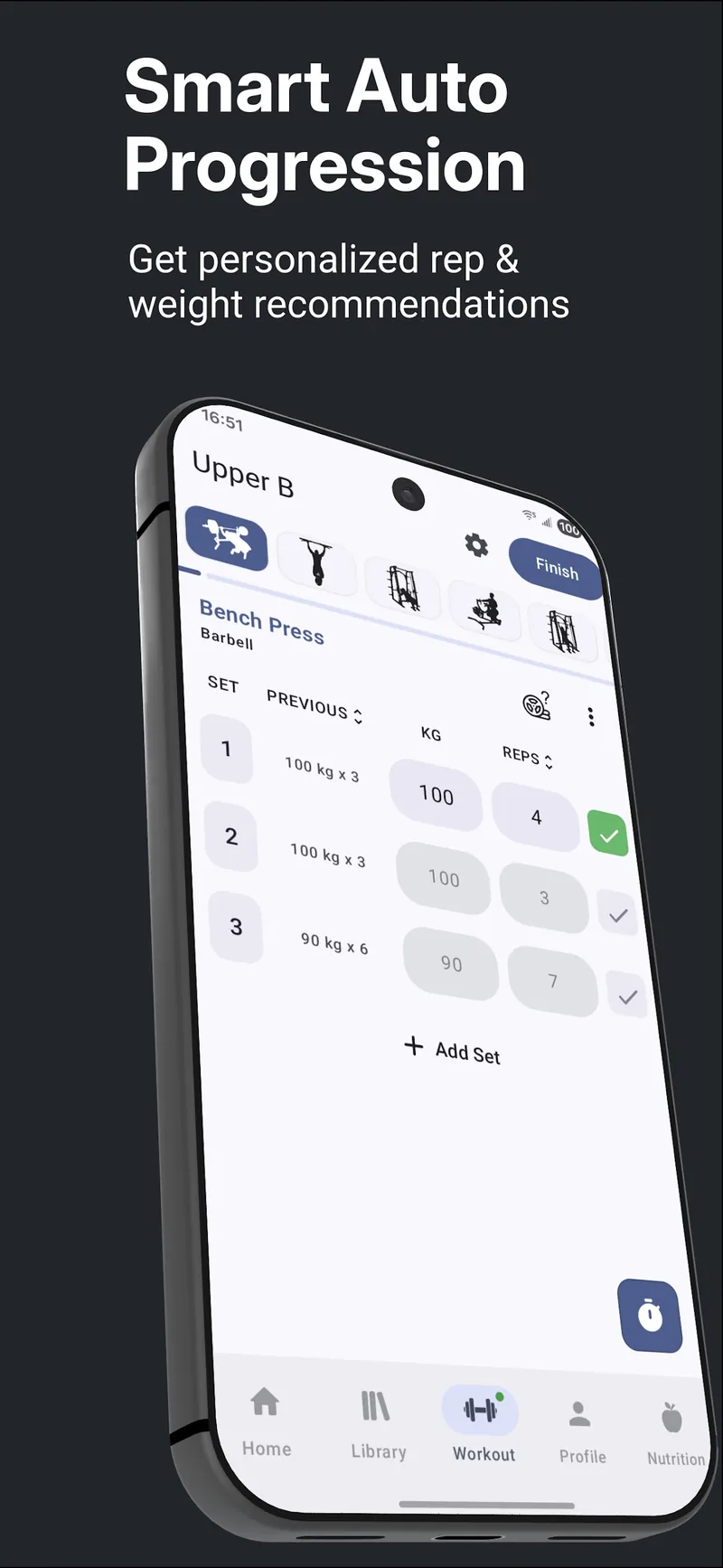 Targets appear per set, next to what you did last time.
GymEvo's free tier records weight, reps and RPE on every set and shows the previous session's numbers next to the set you are about to do, so "did I beat it" is answered while you are still under the bar rather than a month later.
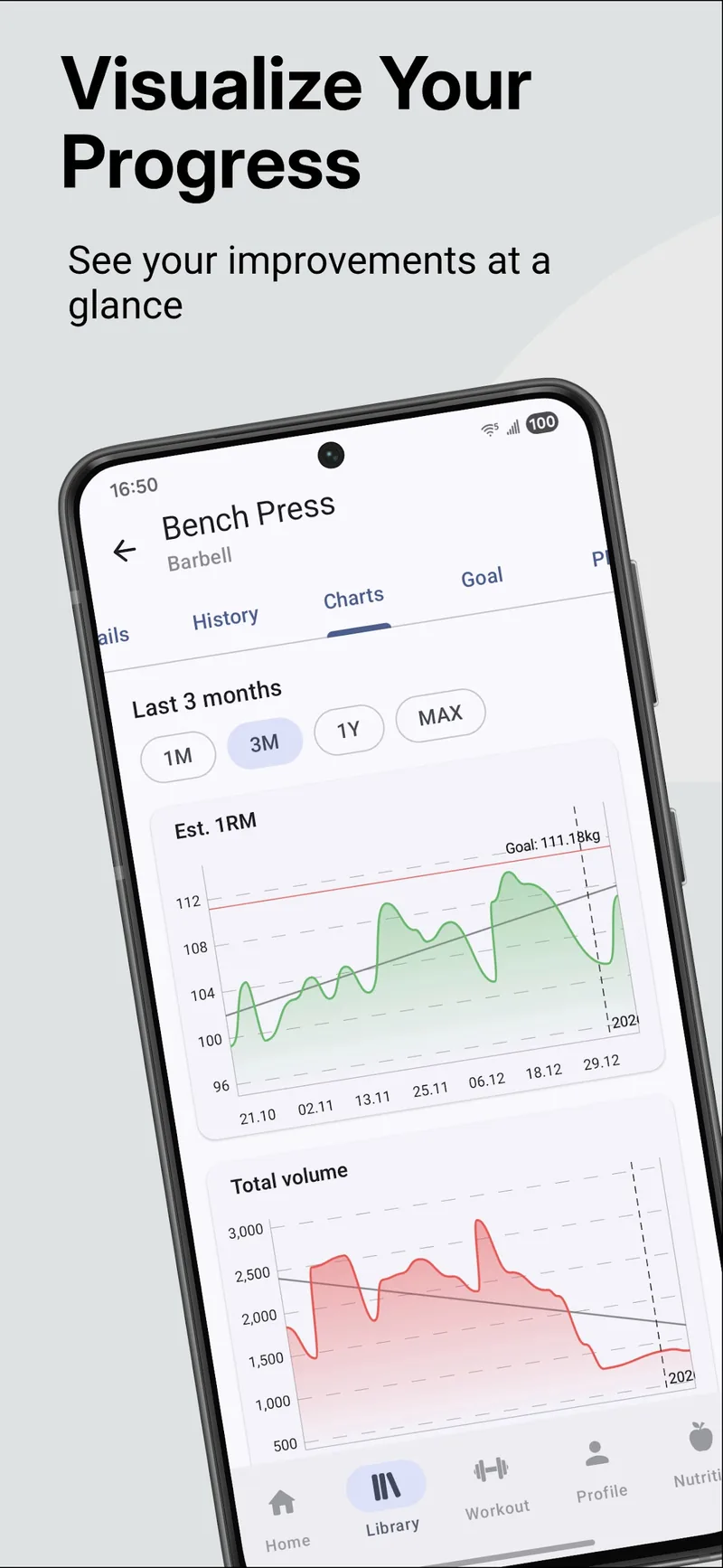 Estimated 1RM and total volume, over any range including your whole history. Both charts are free.
Estimated one-rep max and total volume are charted free over your whole history, which is the window that matters for a muscle that moves in months. See how GymEvo handles progressive overload.
Common mistakes
- Adding exercises instead of weight. Five chest movements at the same loads you used last year is not more training, it is more time.
- Benching with a bar path you cannot repeat. If the bar lands somewhere different every set, the log is not comparable and neither is the stimulus.
- Stopping the press high. The chest does its most useful work near the bottom. Touching the chest under control beats a deeper stack of plates.
- Heavy flyes. The stretched position is the point, and it is also where a shoulder gets hurt. Flyes are a 10 to 15 rep exercise.
- Training chest three times a week with no recovery. Two hard sessions beat three mediocre ones. How often should you train a muscle covers the trade.
- Expecting a chest without calories. Pressing harder on maintenance calories gets you stronger, not bigger. How to bulk up without getting fat covers the surplus.
Sources
- Muscle hypertrophy response across four muscles involved in the bench press exercise: Randomized 10 weeks training intervention — Journal of Bodywork and Movement Therapies (accessed 2026-09-17)
- Effect of Five Bench Inclinations on the Electromyographic Activity of the Pectoralis Major, Anterior Deltoid, and Triceps Brachii during the Bench Press Exercise — International Journal of Environmental Research and Public Health (accessed 2026-09-17)
- Distinct muscle growth and strength adaptations after preacher and incline biceps curls — International Journal of Sports Medicine (accessed 2026-09-17)
- Triceps brachii hypertrophy is substantially greater after elbow extension training performed in the overhead versus neutral arm position — European Journal of Sport Science (accessed 2026-09-17)
- Greater Hamstrings Muscle Hypertrophy but Similar Damage Protection after Training at Long versus Short Muscle Lengths — Medicine and Science in Sports and Exercise (accessed 2026-09-17)
- Low-load bench press and push-up induce similar muscle hypertrophy and strength gain — Journal of Exercise Science and Fitness (accessed 2026-09-17)
- GymEvo exercise catalog (repository mirror of the app's public exercise library) — GymEvo (accessed 2026-09-17)
- GymEvo Free vs Premium: What You Get and When to Upgrade — GymEvo (accessed 2026-09-17)
- GymEvo on the App Store — Apple App Store (accessed 2026-09-17)
Keep reading

Start tracking your training
Download GymEvo and keep your workouts, nutrition, and progress in one place.