Band-Assisted Pull Up
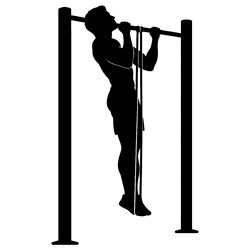
A pull-up with a resistance band looped over the bar under one knee or foot, which helps most at the bottom while you pull with an overhand grip, mainly using your lats.
- Primary muscles
- Lats
- Secondary
- Upper back, Rear delts, Biceps, Forearm flexors
- Difficulty
- Beginner
- Logged as
- Assistance × reps
Loads from YouTube only when you press play. The video is by an independent creator.
Why do it
It's the bar-based way to build toward your first pull-up, and all you need is a band and a bar. Since the band helps most at the bottom and least at the top, you finish each rep largely on your own strength, which carries over well to unassisted pull-ups. The overhand grip makes it a bit harder than the underhand chin-up version, and unlike an assisted machine, there's no pad to steady you. Step down to a lighter band whenever you hit your target reps.
How to do it
Loop a band over the bar and place one knee or foot in the bottom of the loop. Grab the bar with an overhand grip slightly wider than your shoulders.
Hang with straight arms and your shoulders pulled down, away from your ears. The band helps most at the bottom.
Pull your elbows down toward your ribs until your chin is above the bar.
Lower yourself under control until your arms are straight. Log the band you used; a lighter band counts as progress, until you can do pull ups without one.
Common mistakes
Using a band that's too strong
If you fly up out of the bottom, the band is doing the work. Pick one that leaves the last reps hard so you actually build toward unassisted reps.
Stopping above a full hang
Lower until your arms are straight and your shoulders are pulled down. Half reps skip the stretch and make it harder to judge when to drop a band.
Craning your neck at the top
Poking your chin up to clear the bar fakes the last part of the rep. Keep your head neutral and pull your elbows down toward your ribs instead.
Swinging your legs
Keep your core tight and your legs still. Swinging lets momentum carry you past the top, which is the part the band helps least.
Sets, reps and progression
How many sets you do and how close to failure you take them depend on your goal and your week, not on the exercise. These guides cover it:
Alternatives that train the same thing
Same movement, a different angle or piece of equipment.