Helms Row
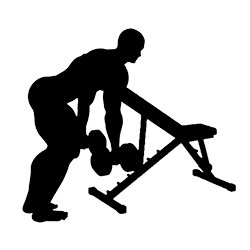
A strict dumbbell row with your chest braced on an incline bench and your feet on the floor: you row the dumbbells toward your hips with your palms facing each other, mainly for your lats.
- Primary muscles
- Lats
- Secondary
- Rear delts, Upper back, Biceps, Forearm flexors
- Difficulty
- Beginner
- Logged as
- Weight × reps
Loads from YouTube only when you press play. The video is by an independent creator.
Why do it
The point of the Helms row is that it's hard to cheat: as long as your chest stays on the pad, your lower back and legs can't help lift the weight. Rowing toward your hips with your elbows close puts the emphasis on your lats rather than your upper back. It's a good pick if your bent-over rows tend to turn into body swings, or when your lower back is already tired from squats or deadlifts. Expect to use lighter dumbbells than in your other rows.
How to do it
Set an incline bench to 30-45 degrees and lie face down with your chest on the pad and your feet on the floor.
Let the dumbbells hang straight down with your palms facing each other, shoulder blades pulled back and down.
Row them in a straight line toward your hips, keeping your elbows close to your body.
Lower them slowly to a full stretch. Keep your chest on the pad for every rep; the whole point of this version is that it can't be cheated.
Common mistakes
Lifting your chest off the pad
Peeling your chest up at the top of each rep turns it into a body swing. If you can't finish with your chest down, the dumbbells are too heavy.
Rowing toward your shoulders
Pulling the dumbbells up and forward shifts the work away from your lats. Row in a straight line toward your hips.
Shrugging at the top
Lifting your shoulders toward your ears lets your traps take over. Keep your shoulder blades back and down as you row.
Rushing the lowering
Lower the dumbbells slowly until your arms hang straight. Dropping them skips the stretch, which is half of what makes this row work.
Sets, reps and progression
How many sets you do and how close to failure you take them depend on your goal and your week, not on the exercise. These guides cover it:
Alternatives that train the same thing
Same movement, a different angle or piece of equipment.