Inverted Row
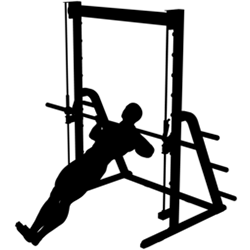
A bodyweight row: lying under a bar set at about waist height, you keep your body straight and pull your chest up to the bar, mainly training your upper back.
- Primary muscles
- Upper back
- Secondary
- Lats, Biceps, Rear delts, Forearm flexors
- Difficulty
- Beginner
- Logged as
- Reps
Loads from YouTube only when you press play. The video is by an independent creator.
Why do it
It's the pulling counterpart to the push-up and one of the simplest ways to train your upper back without weights. It suits beginners who can't do pull-ups yet, since you can make it easier by bending your knees or raising the bar, and harder by putting your feet on a bench. Unlike a bent-over row, there's no hinge to hold, but you do have to keep your body straight like a plank. A bar in a rack or Smith machine works well.
How to do it
Set a bar at about waist height in a rack or Smith machine and lie underneath it.
Grip it overhand slightly wider than shoulder-width, arms straight, heels on the floor and body in a straight line.
Pull your chest to the bar, squeezing your shoulder blades together.
Lower yourself slowly to straight arms. Bend your knees to make it easier, or put your feet on a bench to make it harder.
Common mistakes
Letting your hips sag
A drooping middle shortens the pull and makes it easier. Squeeze your glutes and keep a straight line from your shoulders to your heels.
Stopping well short of the bar
Pull until your chest touches the bar or comes very close. Stopping early skips the squeeze between your shoulder blades.
Leading with your chin
Poking your head forward to reach the bar fakes the top of the rep. Keep your neck neutral and bring your chest to the bar.
Picking the wrong body angle
If you can only manage a few shaky reps, bend your knees or raise the bar. If sets feel easy, lower the bar or put your feet on a bench.
Sets, reps and progression
How many sets you do and how close to failure you take them depend on your goal and your week, not on the exercise. These guides cover it:
Alternatives that train the same thing
Same movement, a different angle or piece of equipment.