Landmine Press
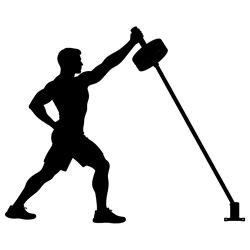
A one-arm press with a barbell anchored in a corner or landmine: from your shoulder, you press the free end up and forward until your arm is straight, training the front delts and upper chest.
- Primary muscles
- Front delts, Upper chest
- Secondary
- Triceps, Serratus
- Difficulty
- Beginner
- Logged as
- Weight × reps
Loads from YouTube only when you press play. The video is by an independent creator.
Why do it
The angled path sits between a shoulder press and an incline press, so it trains the front delts and upper chest together. Many lifters who find straight overhead pressing uncomfortable can press this way without trouble, and you need little more than a bar and a corner. Pressing one arm at a time in a staggered stance also makes your core work to keep you square, and you can add load in small steps with light plates.
How to do it
Wedge one end of a barbell into a corner or landmine attachment and hold the other end at your shoulder with one hand.
Stand in a staggered stance with the opposite foot forward and brace your core.
Press the bar up and forward until your arm is straight, letting your shoulder blade glide forward at the top.
Lower back to your shoulder under control, then switch sides. The angled path is easier on the shoulders than pressing straight overhead.
Common mistakes
Pressing straight up
Pushing vertically fights the arc of the bar. Press up and forward along the path it wants to travel, letting your shoulder blade glide at the top.
Twisting your torso
Rotating your hips and chest to get the bar up turns the press into a twist. Brace your core and keep your hips square in the staggered stance.
Same-side foot forward
With the foot on your pressing side forward, it's harder to stay square. Put the opposite foot forward, as the steps describe.
Elbow flared out to the side
Starting with your elbow out wide takes the upper chest out of it. Keep it slightly in front of your body as you press.
Sets, reps and progression
How many sets you do and how close to failure you take them depend on your goal and your week, not on the exercise. These guides cover it:
Alternatives that train the same thing
Same movement, a different angle or piece of equipment.