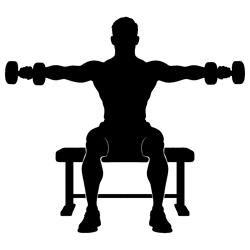
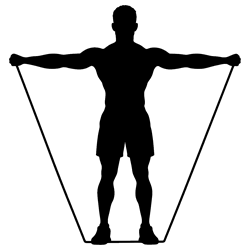
Lateral Raise
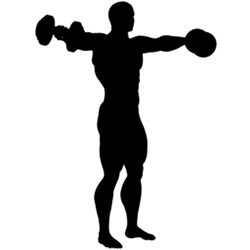
You lift your arms out to the sides until they're about level with your shoulders, then lower them slowly; it's the main isolation move for the side delts.
Equipment
- Primary muscles
- Side delts
- Secondary
- Front delts, Serratus
- Difficulty
- Beginner
- Logged as
- Weight × reps
- Primary muscles
- Side delts
- Secondary
- Front delts, Serratus
- Difficulty
- Beginner
- Logged as
- Weight × reps
- Primary muscles
- Side delts
- Secondary
- Front delts, Serratus
- Difficulty
- Beginner
- Logged as
- Weight × reps

Why do it
Lateral raises suit anyone who wants broader-looking shoulders, since presses mostly train the front delts and leave the side delts underworked. Dumbbells are the easy default and need nothing but a light pair. The cable version trains one side at a time and keeps tension at the bottom, where dumbbells go slack. The machine holds the path for you, so it's the one to push closest to failure without your form falling apart.
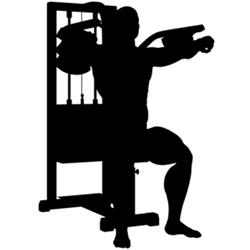
How to do it (Machine)
Set the seat so the pads sit at or just below shoulder height when you're seated.
Sit with your back flat against the pad and place your arms under the pads or on the handles.
Raise your arms out to the sides until they're about level with your shoulders.
Lower slowly under control. The machine holds the path for you, so you can push closer to failure than with dumbbells.
Attach a single handle to the low pulley and stand side-on to the machine, taking the handle in the hand furthest from it so the cable crosses your body.
Start with your arm across your body and the handle in front of your opposite hip, elbow slightly bent.
Raise your arm out to the side until it's about level with your shoulder.
Lower it slowly back across your body. The cable keeps tension on the side delt at the bottom, where a dumbbell has almost none.
Stand with your feet hip-width apart, a dumbbell in each hand at your sides and your elbows slightly bent.
Raise the dumbbells out to the sides until they're roughly level with your shoulders.
Lower them slowly, keeping tension on your side delts.
Keep your torso still. Swinging the weights up hands the work to your traps.
Common mistakes
Swinging the weights up
If your torso rocks to start each rep, momentum is doing the lifting. Drop the weight until you can raise it with your body still.
Shrugging the weight up
When your shoulders creep toward your ears, the traps take over. Think of pushing your hands out wide rather than up, and keep your neck long.
Raising far above shoulder height
Going well past shoulder level shifts the load off the side delts and onto the traps. Stop when your arms are about level with your shoulders.
Letting the weights drop
Letting the weights fall back to your sides skips half the work. Lower them slowly, keeping a little tension on the side delts all the way down.
Sets, reps and progression
How many sets you do and how close to failure you take them depend on your goal and your week, not on the exercise. These guides cover it:
Alternatives that train the same thing
Same movement, a different angle or piece of equipment.