
How to Build Muscle and Lose Fat at the Same Time
Body recomposition is real, and it works best for beginners, people returning after a break, and anyone with fat to lose. The recipe is a small calorie deficit, plenty of protein, and training where the weights keep going up. You judge it by your waist and your lifts, not by the scale.
14 min read
The short answer
To build muscle and lose fat at the same time, eat slightly below maintenance, get enough protein every day, and lift in a way that makes the weights or reps go up over time. The small deficit takes care of the fat. The training decides whether you add muscle while it happens.
That combination is usually called body recomposition, or "recomp". Four numbers do most of the work:
- Calories: about 200 to 400 kcal a day below maintenance. If you're already lean, eat at maintenance instead.
- Protein: at least 1.6 g per kg of bodyweight a day, and closer to 2 g per kg while you're in a deficit.
- Training: each muscle trained about twice a week, with the load or reps creeping up.
- Patience: judge it over 8 to 12 weeks, using your waist and your main lifts, not a single weigh-in.
The rest of this page is how to set those numbers for yourself and how to tell whether it's working.
Can you build muscle and lose fat at the same time?
Yes. Building muscle and losing fat at the same time is realistic for most people who have not been training seriously for years. It's slower and less reliable for lean, experienced lifters.
It works best if you are:
- New to lifting. Your muscles respond to training so strongly in the first year that they grow even when food is a bit short.
- Coming back after a break. Muscle you had before comes back faster than it took to build the first time. Returning to the gym after a break covers where to restart.
- Carrying more body fat than you want. Stored fat covers part of the energy cost, so a small deficit doesn't stop muscle growth as easily.
It's not only a beginner thing. A review of body recomposition in trained lifters found plenty of studies where people who already lifted still gained muscle and lost fat together, as long as the training kept progressing and the nutrition was dialled in.
The size of the deficit is where most people go wrong. A meta-analysis of lifting while dieting found that strength held up fine in a deficit, but muscle gain suffered, and a deficit of around 500 kcal a day was enough to stop it. That's why a recomp uses a smaller gap than a normal diet.
If you're already lean and have trained consistently for years, recomp tends to crawl. Separate phases usually get you further: a lean bulk to build, then a cut where you protect your lifts to lose the fat.
Can you turn fat into muscle?
No. Fat and muscle are different tissues, and one can't turn into the other.
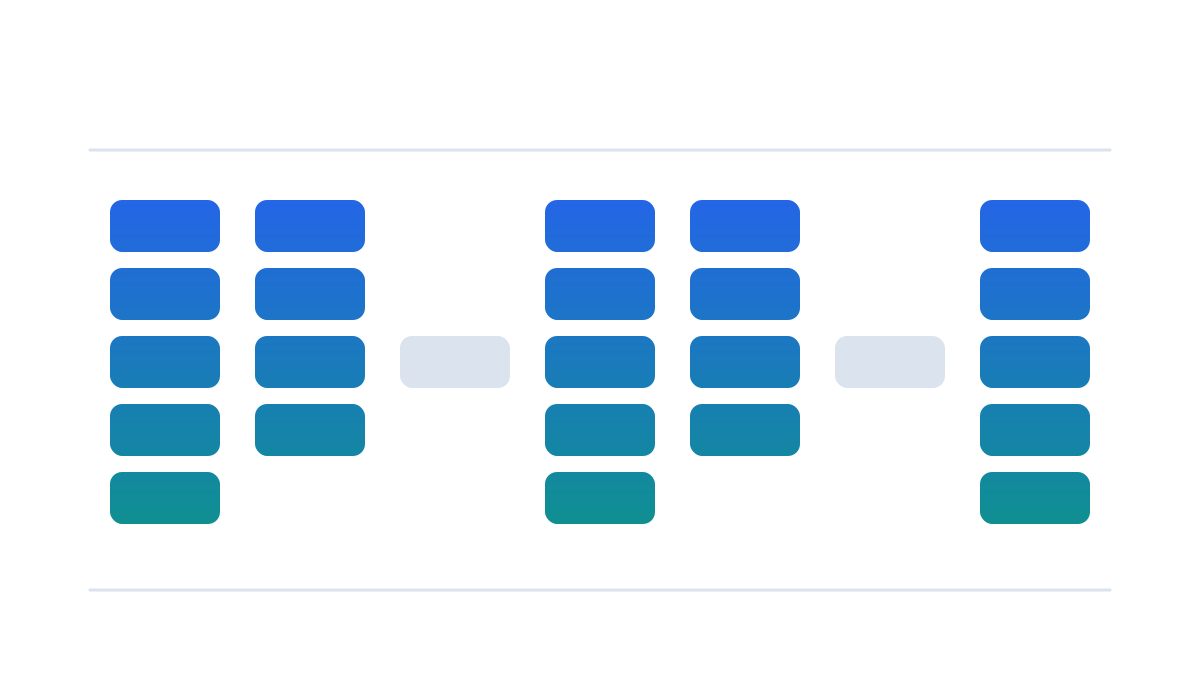
What actually happens during a recomp is two separate processes running side by side:
- Fat shrinks because you eat a little less energy than you use, so your body draws on stored fat.
- Muscle grows because your training gives it a reason to, and protein gives it the material.
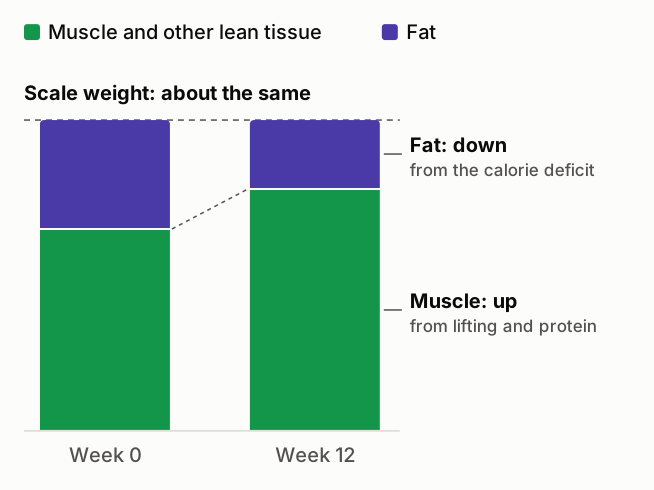 Illustration, not measured data. Fat and muscle change separately, so the scale can barely move while your body changes.
From the outside, that looks like fat turning into muscle: the same bodyweight, a smaller waist, fuller shoulders. It's worth knowing it isn't a conversion, because it explains the method. You need a reason for each half. Burning fat comes from the calorie deficit. Building muscle comes from lifting. Doing only one of them gets you only one of the results.
The reverse myth is wrong too. If you stop training, muscle doesn't "turn into fat". You lose some muscle and, if you keep eating the same, gain some fat. Two separate changes again.
Nutrition: calories and protein
The nutrition side of a recomp has one job: create a small energy gap for fat loss while giving your muscles enough protein to grow.
Set a small deficit
Start from your maintenance calories, then eat 200 to 400 kcal a day less.
The daily calorie needs calculator gives you a maintenance estimate. One thing to watch: its "lose weight" setting cuts a flat 20 percent, which is more than a recomp needs. Read the estimated maintenance line instead and subtract your own number.
Here's a worked example for a 30-year-old woman, 70 kg, 165 cm, lifting three or four times a week:
| Step | Calculation | Result |
|---|---|---|
| Resting energy (Mifflin-St Jeor) | 10 x 70 + 6.25 x 165 - 5 x 30 - 161 | about 1,420 kcal |
| Maintenance | 1,420 x 1.55 (moderately active) | about 2,200 kcal |
| Calculator's "lose weight" setting | 2,200 x 0.8 | about 1,760 kcal |
| Recomp target | 2,200 - 200 to 400 | 1,800 to 2,000 kcal |
| Protein | 1.6 to 2.2 g x 70 kg | 112 to 154 g a day |
The calculator's number is a starting estimate, not a measurement of you. After three weeks of logging food and weighing yourself, your own data corrects it. The playbook further down shows how.
Hit your protein every day
Protein is the part of a recomp you shouldn't skimp on. A large meta-analysis of protein and lifting found that muscle gains stopped increasing above roughly 1.6 g per kg of bodyweight a day, so treat 1.6 as your floor. In a deficit, needs go up: a review of dieting lifters recommends higher intakes, and around 2 g per kg covers most people doing a moderate recomp.
For the 70 kg example, 140 g a day could look like this:
- Breakfast: Greek yogurt with oats and berries, about 30 g
- Lunch: chicken or tofu with rice and vegetables, about 40 g
- Afternoon: a protein shake or cottage cheese, about 25 g
- Dinner: fish, lean beef or lentils with potatoes, about 45 g
Four meals with 25 to 45 g each is easier than trying to fit it all into dinner.
Carbs and fat
Once calories and protein are set, carbs and fat can fill the rest in whatever mix you like.
Two practical limits: don't drop fat so low that meals stop being satisfying, and keep enough carbs around your workouts to train hard. A recomp lives or dies on training quality, and a session on an empty tank won't push your lifts up.
Logging food in GymEvo
GymEvo's free food log covers the nutrition side: barcode scanning, a public food database, macros per meal, and a calorie target you set yourself or calculate. The target can adjust automatically from your weigh-ins, which saves you doing the three-week correction by hand.
Training: progressive overload builds the muscle
A calorie deficit loses fat on its own. Muscle only comes along if your training asks for it, and the way to ask is progressive overload: doing a little more over time.
What a recomp training week looks like
Three or four sessions a week is enough. A simple setup:
- Full body, 3 days a week, or upper/lower, 4 days a week
- One or two compound lifts per session, such as a squat, deadlift variation, bench press, row, or overhead press
- A few accessories for arms, shoulders, and whatever you want to bring up
- Around 10 hard sets per muscle per week as a starting point, spread over two sessions
How many sets per week to build muscle goes deeper on volume. If you don't have a plan yet, the free workout plan generator builds a weekly split from your available days and equipment.
Repeat the same plan for at least 8 to 12 weeks. Changing exercises every week makes it impossible to see whether you're getting stronger.
Add weight or reps over time
Your lifts going up is the clearest sign a recomp is building muscle. The easiest method is double progression:
- Pick a rep range, for example 8 to 12.
- Start with a weight you can lift for 8 reps on every set.
- Add a rep here and there each session.
- When you hit 12 reps on every set, add the smallest weight step and go back to 8.
Example: 3 sets of 8 on dumbbell rows with 20 kg. A few weeks later, 3 sets of 12. Next session, 22 kg for 3 sets of 8.
In a deficit, progress will be slower than in a bulk. Holding your weights while your bodyweight drops is still progress. The progressive overload guide and how much weight to add cover the details.
Where cardio fits
Cardio helps, but it's not a replacement for lifting. It's one of the ways to create the deficit, and it's good for your heart. It won't build much muscle.
The easiest lever is daily steps. Walking burns energy without eating into your recovery the way hard intervals can. If you add hard cardio, keep it away from your leg days so it doesn't cost you reps on squats.
Logging lifts in GymEvo
GymEvo's workout log shows what you did last session on the exercise you're about to do, so you know exactly what to beat. The estimated one-rep max chart per exercise is free and shows whether your strength is trending up over weeks, which is exactly what you need to check a recomp.
How to lose belly fat and gain muscle
You can't choose where fat comes off, so losing belly fat works the same way as losing fat anywhere: a calorie deficit plus lifting. Ab exercises strengthen the muscles underneath but don't burn the fat on top of them.
That's been tested directly. In one study, adults did seven ab exercises five days a week for six weeks and lost no belly fat compared with people who didn't. Their ab endurance improved. Their waist didn't.
What works for belly fat and muscle at the same time:
- A steady small deficit. Belly fat goes as overall body fat goes, on a schedule you don't get to pick.
- Heavy compound lifts. Squats, deadlifts, and rows build a lot of muscle and train your core along the way.
- Direct core training for strength, not definition. How to build core strength covers what's worth doing.
- A tape measure. Measure your waist at the navel every two weeks, same time of day. It's the most useful number for belly fat, and it often moves when the scale doesn't.
Building muscle and losing fat for women
For women, building muscle and losing fat works the same way as for men: a small deficit, enough protein per kg of bodyweight, and progressive overload. The differences are about expectations and tracking, not about a different method.
Muscle comes on more slowly in absolute terms. A rough planning figure is that a beginner woman gains about half as much muscle per month as a beginner man, with wide individual variation (how long it takes to see results has the full picture). That's why the scale can stay flat for weeks while your clothes fit differently.
Lifting heavy won't make you bulky. Building noticeable size takes years of deliberate effort and eating in a surplus. In a recomp you're eating below maintenance, so the realistic outcome is a firmer, more defined look and a smaller waist. Train in the 6 to 15 rep range with weights that feel hard by the last few reps.
Your cycle moves the scale. Water retention changes across the menstrual cycle. In a year-long diary study, women reported the most bloating around the first day of their period and the least in the week or so after it. A jump of a kilo or more in those days is usually water, not fat. Compare your weekly average with the same week of your previous cycle, or look at monthly trends.
Don't under-eat to speed it up. A deep deficit costs you muscle and makes training feel awful. Missed periods, constant fatigue, or poor sleep are signals to eat more and talk to a doctor, not to push harder.
Protein targets don't change. The same 1.6 to 2 g per kg applies, which for a 60 kg woman is about 95 to 120 g a day.
A 12-week recomp playbook
This is the whole plan in order. It turns the numbers above into weekly checks, so you're making decisions from data instead of from one bad weigh-in.
Week 0: set your baseline
- Weigh yourself every morning for a week, after the bathroom and before eating. Write down the average.
- Measure your waist at the navel.
- Pick three main lifts and note your best set on each, for example squat, bench press, and row.
- Set your calorie and protein targets from the nutrition section.
Weeks 1 to 12: the routine
- Log every workout and try to beat last session by a rep or a small weight step.
- Log food on most days, at least until you know your usual meals well.
- Weigh in most mornings and compare weekly averages, never single days.
- Measure your waist every two weeks.
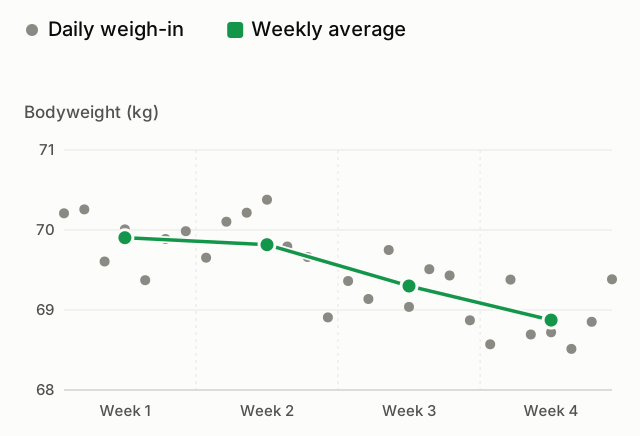 Compare weekly averages, not single days: one salty meal or a water spike can hide a week of progress. Made-up data for illustration.
Every three weeks: check and adjust
| Scale (weekly average) | Waist | Main lifts | What it means | What to do |
|---|---|---|---|---|
| Down slowly | Down | Up or holding | It's working | Change nothing |
| Flat | Down | Up | Classic recomp: fat down, muscle up | Change nothing |
| Down fast | Down | Going down | Deficit is too big | Eat about 150 to 200 kcal more |
| Flat | Flat | Flat | No real deficit, or gaps in logging | Log more carefully for a week, then eat 150 to 200 kcal less |
| Up | Up | Up | You're in a surplus | Decide on purpose: bulk, or trim 150 to 200 kcal |
Change one thing at a time, and give each change three weeks. Weekly adjustments end up chasing water weight.
After 12 weeks, look at the whole block. If your waist is down and your lifts are up, run another block. If progress has stalled for a lean, experienced lifter, it may be time to switch to a dedicated bulk or cut.
Track calories and lifts in one app: GymEvo is free
A recomp needs two records side by side: what you ate and what you lifted. Keeping both in one app is the practical reason to use GymEvo.
Free, with no subscription:
- Food logging with barcode scanning, macros, and a calorie target that can adjust from your weigh-ins
- Bodyweight logging with a gain, loss, or maintenance target, and a bodyweight chart over your whole history
- Unlimited workout logging with last session's numbers shown while you log
- An estimated one-rep max chart per exercise
That's the full recomp feedback loop from the playbook, at no cost.
Premium adds convenience and analysis on top: the calorie chart, weekly and monthly reviews that summarize whether the block is going anywhere, automatic progression that proposes your next weight per exercise, and calorie estimates from a photo of your meal. GymEvo free vs Premium lists both sides honestly.
See how GymEvo helps you build muscle and download the app.
Common mistakes
- Cutting calories too hard. A big deficit loses fat faster but stops muscle gain and drags your lifts down. Small and steady is the point of a recomp.
- Judging it by the scale. In a good recomp the scale can sit still for weeks. Your waist and your lifts tell the real story.
- Switching to light weights and high reps to "tone". Tone is muscle with less fat over it. Light, easy sets don't give your muscles a reason to grow.
- Replacing lifting with cardio. Cardio helps the deficit. It doesn't build the muscle.
- Letting protein slip on busy days. It's the one number to hit every day, especially when calories are lower.
- Changing the plan every week. New exercises and new calorie targets every week leave you with nothing to compare.
- Quitting at week four. Recomp is slow. Most of the visible change shows up in the second and third month.
A note on health: this page is general education, not individual medical or dietetic advice. The right calorie target depends on your health, medication, training, and history. If you are pregnant, managing a medical condition, or have any history of disordered eating, talk to a qualified professional before starting a deficit or tracking food. Persistent fatigue, a missed period, poor sleep, or feeling unwell are reasons to stop dieting and get checked rather than to push harder.
Sources
- Body Recomposition: Can Trained Individuals Build Muscle and Lose Fat at the Same Time? — Strength and Conditioning Journal (accessed 2026-09-22)
- Body Recomposition: Can Trained Individuals Build Muscle and Lose Fat at the Same Time? (Semantic Scholar record with abstract) — Semantic Scholar (accessed 2026-09-22)
- Energy deficiency impairs resistance training gains in lean mass but not strength: A meta-analysis and meta-regression — Scandinavian Journal of Medicine & Science in Sports (accessed 2026-09-08)
- A systematic review, meta-analysis and meta-regression of the effect of protein supplementation on resistance training-induced gains in muscle mass and strength in healthy adults — British Journal of Sports Medicine (accessed 2026-09-22)
- A Systematic Review of Dietary Protein During Caloric Restriction in Resistance Trained Lean Athletes: A Case for Higher Intakes — International Journal of Sport Nutrition and Exercise Metabolism (accessed 2026-09-08)
- A new predictive equation for resting energy expenditure in healthy individuals — American Journal of Clinical Nutrition (accessed 2026-09-02)
- Daily Calorie Needs Calculator — GymEvo (accessed 2026-09-22)
- The effect of abdominal exercise on abdominal fat — Journal of Strength and Conditioning Research (accessed 2026-09-17)
- Fluid Retention over the Menstrual Cycle: 1-Year Data from the Prospective Ovulation Cohort — Obstetrics and Gynecology International (accessed 2026-09-22)
- Fluid Retention over the Menstrual Cycle (Semantic Scholar record with abstract) — Semantic Scholar (accessed 2026-09-22)
- How long until you see results from lifting — GymEvo (accessed 2026-09-22)
- GymEvo Free vs Premium: What You Get and When to Upgrade — GymEvo (accessed 2026-09-22)
Keep reading




Start tracking your training
Download GymEvo and keep your workouts, nutrition, and progress in one place.