
Macro Calculator: Protein, Carbs and Fat for Your Goal
Turn your calorie target into grams of protein, carbs and fat for losing fat, maintaining or building muscle, with every step and source shown.
By Jobri Fitness
Daily calories
2,556
kcal/day
Estimated maintenance, the same estimate as the daily calorie needs calculator
| Macro | Grams per day | Calories | Share |
|---|---|---|---|
| Protein | 112 g | 448 kcal | 17.5% |
| Fat | 71 g | 639 kcal | 25% |
| Carbs | 367 g | 1,469 kcal | 57.5% |
Protein per meal
3 meals
37 g
4 meals
28 g
5 meals
22 g
A starting estimate for adults, not a measurement or medical advice. Adjust it after 2 to 3 weeks of logging food and weighing yourself.
In GymEvo: 20% protein, 25% fat, 55% carbs
GymEvo sets macro targets as percentages in steps of 5 that add up to 100. At 2,556 kcal this split gives about 128 g protein, 71 g fat and 351 g carbs. Logging food and setting these targets is free. See the free calorie counter
The short answer
Set protein from your body weight, give fat about a quarter of your calories, and let carbs fill the rest. For most people who lift, that's 1.6 to 2.2 g of protein per kg / 0.7 to 1 g of protein per pound of body weight a day, a little more while dieting. Your macro percentages then follow from your calories, so they change when your calories do.
How to use the macro calculator
- Choose metric or imperial units.
- Enter your gender, age, height and body weight, and pick the activity level that matches a typical week.
- Pick your goal: lose fat, maintain, or build muscle.
- Keep "Estimate them for me" to use the same calorie estimate as the daily calorie needs calculator, or choose "I know my target" and type in your own number.
- Choose a protein level and a fat share. The preselected ones suit most people.
You get grams, calories and the share of calories for each macro, protein per meal for three to five meals, and the same targets as a percentage split you can enter in GymEvo.
How the calculator works
No calculator can measure your metabolism, so the honest answer to "which macro calculator is most accurate" is the one whose steps you can check. Here are all four.
1. Calories
Unless you enter your own target, the calculator uses the same estimate as the daily calorie needs calculator: resting energy from the Mifflin-St Jeor equation, multiplied by an activity factor, then 20% less to lose fat or 20% more to build muscle.
That fixed 20% is a simple default. It's more than a body recomposition or a lean bulk needs, and both guides work out a smaller number from your maintenance calories. If you have that number, choose "I know my target" and enter it.
2. Protein, set by body weight
| Goal | Preselected | Options |
|---|---|---|
| Lose fat | 2 g per kg / 0.9 g per pound | 1.6, 2, 2.3 or 2.6 g per kg / 0.7, 0.9, 1 or 1.2 g per pound |
| Maintain | 1.6 g per kg / 0.7 g per pound | 1.6, 1.8, 2 or 2.2 g per kg / 0.7, 0.8, 0.9 or 1 g per pound |
| Build muscle | 1.6 g per kg / 0.7 g per pound | 1.6, 1.8, 2 or 2.2 g per kg / 0.7, 0.8, 0.9 or 1 g per pound |
Protein is the one macro tied to your body rather than to your calories. A large review of protein and lifting found that muscle gains stopped increasing at around 1.6 g per kg / 0.7 g per pound of body weight a day, so that's the floor here and anything above it is margin.
A diet changes the picture. The sports nutrition society's position on protein puts most people who exercise at 1.4 to 2 g per kg / 0.6 to 0.9 g per pound a day and says lifters in a calorie deficit may need more to hold on to muscle, which a review of dieting lifters also found. That's why "lose fat" starts at 2 g per kg / 0.9 g per pound. The two higher options are for lean people cutting hard.
3. Fat, as a share of calories
Fat is preselected at 25% of your calories, and you can choose between 20% and 35%. That's the range the US Dietary Guidelines list as acceptable for adults, and a review of diets for natural bodybuilders suggests a similar 15% to 30% while dieting.
On a small calorie target, a percentage can drop fat lower than most people find satisfying, so the calculator never goes below 0.5 g per kg / 0.2 g per pound of body weight, the bottom of the range in a review of nutrition for building muscle. If it has to raise fat to that floor, the result says so.
4. Carbs fill the rest
carbs (g) = (calories - protein (g) x 4 - fat (g) x 9) / 4
Protein and carbohydrate count as 4 kcal per gram and fat as 9, the general factors US nutrition labels use. If protein and fat already use up your calories, the calculator tells you instead of showing a negative number. In "build muscle" mode it also points out when carbs come in under 3 g per kg / 1.4 g per pound, because the same review of building muscle recommends at least that much.
The split you can enter in GymEvo
GymEvo sets macro targets as whole percentages in steps of 5 that add up to 100. The calculator rounds your targets to the nearest such split, giving any leftover step to the share that was closest to rounding up, and shows how many grams that split works out to at your calories.
Worked examples
Maintaining, for a man
A 30-year-old man, 80 kg and 180 cm, moderately active, who wants to maintain:
| Step | Calculation | Result |
|---|---|---|
| Calories | Maintenance estimate | 2,759 kcal |
| Protein | 1.6 x 80 | 128 g (512 kcal, 18.6%) |
| Fat | 25% of 2,759 kcal = 690 kcal, 690 / 9 | 77 g (25%) |
| Carbs | (2,759 - 512 - 690) / 4 | 389 g (56.4%) |
| GymEvo split | 20% protein, 25% fat, 55% carbs | about 138 g, 77 g and 379 g |
A 30-year-old man, 175 lb and 5 ft 11 in, moderately active, who wants to maintain:
| Step | Calculation | Result |
|---|---|---|
| Calories | Maintenance estimate | 2,753 kcal |
| Protein | 0.7 x 175 | 123 g (490 kcal, 17.8%) |
| Fat | 25% of 2,753 kcal = 688 kcal, 688 / 9 | 76 g (25%) |
| Carbs | (2,753 - 490 - 688) / 4 | 394 g (57.2%) |
| GymEvo split | 20% protein, 25% fat, 55% carbs | about 138 g, 76 g and 379 g |
Protein is under a fifth of his calories, far from the 30% or 40% that fixed splits often assume, and he still gets all the protein the research supports.
Losing fat, for a woman
The method is the same for women. Only the inputs change.
A 35-year-old woman, 65 kg and 165 cm, lightly active, who wants to lose fat:
| Step | Calculation | Result |
|---|---|---|
| Calories | 1,850 x 0.8 | 1,480 kcal |
| Protein | 2 x 65 | 130 g (520 kcal, 35.1%) |
| Fat | 25% of 1,480 kcal = 370 kcal, 370 / 9 | 41 g (25%), above the 33 g floor |
| Carbs | (1,480 - 520 - 370) / 4 | 148 g (39.9%) |
| GymEvo split | 35% protein, 25% fat, 40% carbs | about 130 g, 41 g and 148 g |
A 35-year-old woman, 145 lb and 5 ft 5 in, lightly active, who wants to lose fat:
| Step | Calculation | Result |
|---|---|---|
| Calories | 1,861 x 0.8 | 1,489 kcal |
| Protein | 0.9 x 145 | 131 g (522 kcal, 35.1%) |
| Fat | 25% of 1,489 kcal = 372 kcal, 372 / 9 | 41 g (25%), above the fat floor |
| Carbs | (1,489 - 522 - 372) / 4 | 149 g (39.9%) |
| GymEvo split | 35% protein, 25% fat, 40% carbs | about 130 g, 41 g and 149 g |
Here protein is over a third of the calories. Same rules, very different percentages, because the calories are lower and the protein target goes up in a deficit.
Why fixed ratios like 40/30/30 can mislead
Splits like 40/30/30 (40% carbs, 30% protein, 30% fat) or 40/40/20 hand out protein as a share of calories. But your protein needs follow your body weight, not your calories, so the same ratio gives very different amounts depending on how much you eat. For an 80 kg / 175 lb lifter on a 40/30/30 split:
- At 1,500 kcal, 30% protein is about 113 g, or 1.4 g per kg / 0.6 g per pound. That's below the 2 g per kg / 0.9 g per pound that suits most people in a deficit, right when holding on to muscle matters most.
- At 3,500 kcal, it's about 263 g, or 3.3 g per kg / 1.5 g per pound. That's well past the point where more protein builds more muscle, and those calories could have been carbs for training.
A 40/40/20 split puts 40% on protein. That lands closer on a diet, about 150 g at 1,500 kcal, but even further over on a bulk.
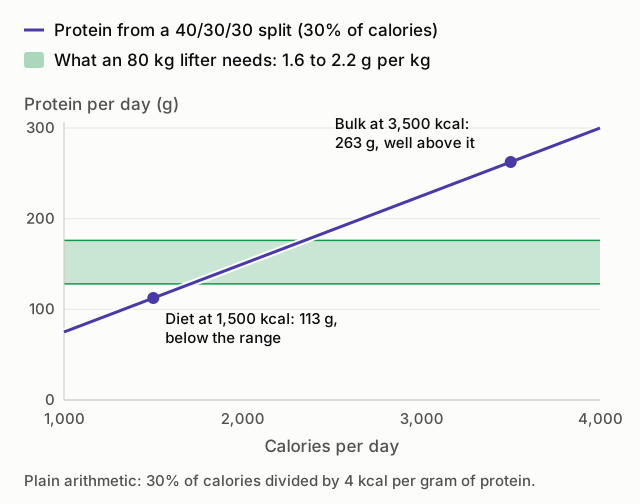 A fixed ratio only hits the protein range in a narrow band of calories. Plain arithmetic for one 80 kg lifter.
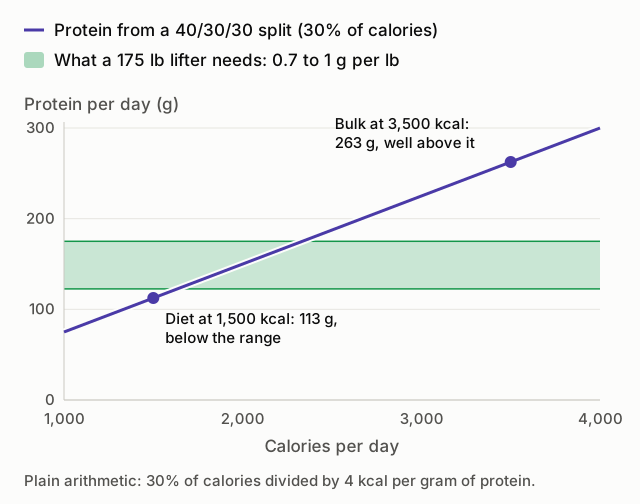 A fixed ratio only hits the protein range in a narrow band of calories. Plain arithmetic for one 175 lb lifter.
Ratios aren't wrong as a way to enter targets. GymEvo uses percentages too. They just make a poor starting point. Work out protein from your body weight first, then turn the result into a ratio, which is what this calculator does.
Tracking your macros in GymEvo
A target only helps if you track against it. GymEvo's food log is free: barcode scanning, a food database, quick calorie and macro entries, and macros per meal and per day. You set calories and macro percentages in the nutrition goal screen, and the calorie target can follow your weigh-ins automatically. AI estimates from a meal photo or a spoken description are part of Premium. See GymEvo's free calorie counter.
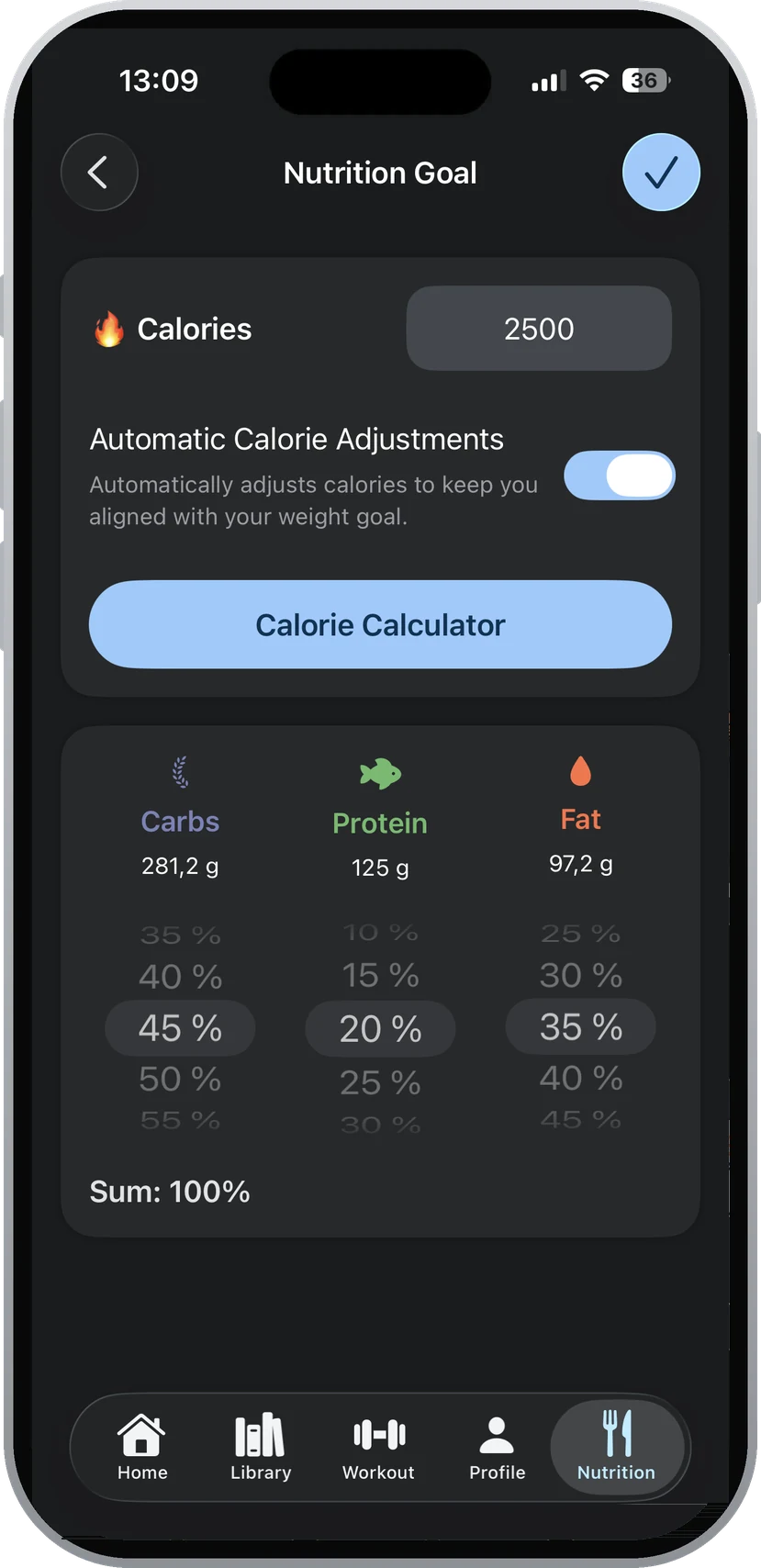 The nutrition goal screen: macro targets move in steps of 5% and have to add up to 100%.
For the day-to-day side, how to count macros covers weighing, logging and what precision actually matters.
Assumptions and limitations
- The result is a starting estimate, not a measurement. After 2 to 3 weeks of logging food and weighing yourself, your own trend tells you whether the calories are right.
- The calorie estimate is for adults aged 18 to 100. The original Mifflin-St Jeor study included ages 19 to 78, so estimates outside that range may be less reliable.
- The calculator doesn't split a target below 1,000 kcal a day. The NIDDK Body Weight Planner warns that food-group targets and nutrient recommendations will not be met below that level.
- If you're pregnant or breastfeeding, have kidney disease, take medication for diabetes, or have a history of disordered eating, set your targets with a doctor or registered dietitian rather than a calculator. Tracking macros closely isn't a good idea for everyone.
Sources
- A new predictive equation for resting energy expenditure in healthy individuals, The American Journal of Clinical Nutrition (accessed 2026-10-18)
- Daily Calorie Needs Calculator: Estimate Calories (GymEvo, the publisher's own tool), Jobri Fitness (accessed 2026-10-18)
- A systematic review, meta-analysis and meta-regression of the effect of protein supplementation on resistance training-induced gains in muscle mass and strength in healthy adults, British Journal of Sports Medicine (accessed 2026-10-18)
- International Society of Sports Nutrition Position Stand: protein and exercise, Journal of the International Society of Sports Nutrition (accessed 2026-10-18)
- A Systematic Review of Dietary Protein During Caloric Restriction in Resistance Trained Lean Athletes: A Case for Higher Intakes, International Journal of Sport Nutrition and Exercise Metabolism (accessed 2026-10-18)
- Dietary Guidelines for Americans, 2020-2025, Appendix 1, U.S. Department of Agriculture and U.S. Department of Health and Human Services (accessed 2026-10-18)
- Evidence-based recommendations for natural bodybuilding contest preparation: nutrition and supplementation, Journal of the International Society of Sports Nutrition (accessed 2026-10-18)
- Nutrition Recommendations for Bodybuilders in the Off-Season: A Narrative Review, Sports (MDPI) (accessed 2026-10-18)
- 21 CFR 101.9, Nutrition labeling of food, Electronic Code of Federal Regulations (accessed 2026-10-18)
- Body Weight Planner, National Institute of Diabetes and Digestive and Kidney Diseases (accessed 2026-10-18)
- Macro Calculator: Protein, Carbs and Fat for Your Goal (GymEvo, the publisher's own tool), Jobri Fitness (accessed 2026-10-18)
- GymEvo app capabilities, Jobri Fitness (accessed 2026-10-18)
- GymEvo Free vs Premium: What You Get and When to Upgrade, Jobri Fitness (accessed 2026-10-18)
- Research Behind the Body Weight Planner, National Institute of Diabetes and Digestive and Kidney Diseases (accessed 2026-10-18)
Keep reading


Start tracking your training
Download GymEvo and keep your workouts, nutrition, and progress in one place.