Band-Assisted Dips
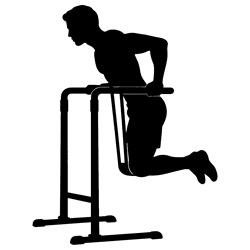
On parallel bars with a band looped under your knees, you lower and press your body weight while the band gives you a boost, most of all at the bottom.
- Primary muscles
- Lower chest, Triceps
- Secondary
- Middle chest, Upper chest, Front delts
- Difficulty
- Beginner
- Logged as
- Assistance × reps
Loads from YouTube only when you press play. The video is by an independent creator.
Why do it
Band-assisted dips suit you when full dips are still out of reach and there's no assisted machine around. The band helps most at the bottom, where dips are hardest, and less near the top, so the lockout feels close to a real dip. That makes it a natural bridge, but it can also hide a weak bottom position, so practice slow lowering and don't stay on the same band for too long. Lean slightly forward to bring in more chest.
How to do it
Loop a band across the dip bars and kneel on it, or place one knee in the loop. Grab the bars with your palms facing each other.
Press up until your arms are straight, with your shoulders down and your chest up. The band helps most at the bottom.
Bend your elbows to lower yourself until your upper arms are about parallel to the floor, leaning your torso slightly forward.
Press back up until your arms are straight. Log the band you used; a lighter band counts as progress, until you can do dips without one.
Common mistakes
Bouncing off the band
Dropping fast and letting the band catapult you up skips the hardest part of the rep. Lower under control and press up with your arms.
Band shifting on the bars
If the band slides along the bars or your knee slips out of the loop, every rep feels different. Loop it securely and keep your knee centered in it.
Staying on a thick band too long
A strong band can make the bottom almost free. Move to a lighter band once you can do clean sets, even if your reps drop at first.
Sinking deeper than you can control
The band makes it easy to drop further than your shoulders like. Stop when your upper arms are about parallel to the floor.
Sets, reps and progression
How many sets you do and how close to failure you take them depend on your goal and your week, not on the exercise. These guides cover it:
Alternatives that train the same thing
Same movement, a different angle or piece of equipment.