Band Chest Press
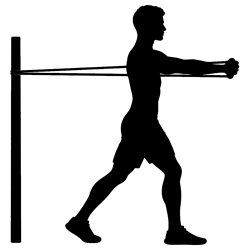
Standing in a split stance with a band anchored behind you, you press both hands forward from your chest to straight arms, then let them return slowly.
- Primary muscles
- Upper chest, Middle chest, Lower chest
- Secondary
- Front delts, Triceps
- Difficulty
- Beginner
- Logged as
- Band × reps
Loads from YouTube only when you press play. The video is by an independent creator.
Why do it
This is a pressing option for home, travel or warm-ups, with no bench and no weights. The band pulls hardest at full extension and least at your chest, so it feels very different from free weights: the start is easy and the lockout is the tough part. Standing also means your core has to keep the band from pulling you backward. It works well for higher reps or for beginners building toward push-ups, and you progress with a stronger band or a step further forward.
How to do it
Anchor a band at chest height behind you and hold one end in each hand beside your chest, elbows bent and slightly below shoulder height. Step forward with one foot in front of the other until the band is taut.
Press your hands forward until your arms are straight in front of your chest.
Keep your torso upright and your shoulders down; do not lean into the press.
Let your hands return slowly to your chest. Log the band you used; a stronger band counts as progress.
Common mistakes
Leaning into the press
Throwing your body weight forward stretches the band without much chest work. Stay upright and let only your arms move.
Shoulders hiking up near lockout
As the band gets heavy at the end, your shoulders tend to shrug and round forward. Keep them down and finish the press with your arms.
Elbows up at shoulder height
Starting with your elbows level with your shoulders turns the press into an awkward, shoulder-heavy push. Keep them slightly below shoulder height.
Letting the band yank you back
If your hands snap back to your chest, you skip the lowering half of the rep. Bring them back slowly against the band.
Sets, reps and progression
How many sets you do and how close to failure you take them depend on your goal and your week, not on the exercise. These guides cover it:
Alternatives that train the same thing
Same movement, a different angle or piece of equipment.