Banded Push Up
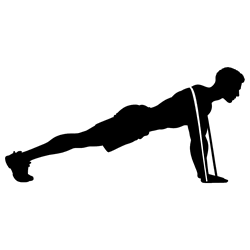
A push-up with a band across your upper back and pinned under your hands, so the resistance builds as you press up toward straight arms.
- Primary muscles
- Upper chest, Middle chest, Lower chest
- Secondary
- Front delts, Triceps
- Difficulty
- Intermediate
- Logged as
- Band × reps
Loads from YouTube only when you press play. The video is by an independent creator.
Why do it
Banded push-ups let you keep progressing once regular push-ups get easy and you have no weight vest or plates. The band adds little at the bottom and the most at lockout, which matches where you're strongest in a push-up. That makes it a good fit for harder sets in lower rep ranges, and a band is easy to pack for training away from the gym. Choose a band that still lets you reach full depth with a straight body; moving to a thicker one counts as progress.
How to do it
Hold one end of a band in each hand and run it across your upper back, at the level of your shoulder blades. Get into a push up position with your hands under your shoulders, pinning the band ends to the floor.
Lower your chest to just above the floor, keeping your body in a straight line from head to heels.
Push back up against the band until your arms are straight.
Keep your elbows at about 45 degrees to your body throughout. Log the band you used; a stronger band counts as progress.
Common mistakes
Band slipping off your back
If the band rides up toward your neck or slides down to your lower back, the pull gets uneven. Keep it across your shoulder blades.
Band ends creeping out
If the band slides out from under your palms mid-set, the resistance drops. Wrap each end once around your hand so it stays pinned.
Hips sagging near lockout
The extra pull at the top tends to drop your hips. Squeeze your glutes and brace so your body stays in a straight line.
Stopping short of straight arms
With a strong band, reps often end well before lockout, where the band works hardest. Pick a band that still lets you finish every rep.
Sets, reps and progression
How many sets you do and how close to failure you take them depend on your goal and your week, not on the exercise. These guides cover it:
Alternatives that train the same thing
Same movement, a different angle or piece of equipment.