Bench Dips
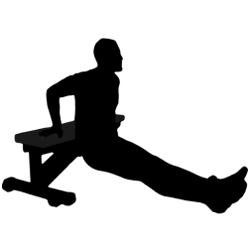
With your hands on the edge of a bench behind you and legs out in front, you bend your elbows straight back to lower your hips, then press back up, mainly working the triceps.
- Primary muscles
- Triceps
- Secondary
- Upper chest, Middle chest, Lower chest, Front delts
- Difficulty
- Beginner
- Logged as
- Reps
Loads from YouTube only when you press play. The video is by an independent creator.
Why do it
It's one of the simplest bodyweight triceps exercises and needs only a bench, chair or step, which makes it a common beginner and home option. Compared with dips on parallel bars, your feet take some of your weight, so it's easier; bend your knees to make it easier still, or rest your feet on a second bench to make it harder. The trade-off is the position: your hands sit behind you, which stretches the front of the shoulder a lot at the bottom, so keep the depth moderate.
How to do it
Sit on the edge of a bench and grip the edge next to your hips, fingers pointing forward.
Slide your hips off the bench with your legs extended in front of you and your arms straight.
Bend your elbows straight back to lower yourself until your upper arms are roughly parallel to the floor.
Press back up through your palms. Stop the descent where your shoulders feel comfortable; this position stretches the front of the shoulder more than parallel-bar dips do.
Common mistakes
Sinking too deep
Dropping until your elbows are sharply bent pushes the front of your shoulder into a big stretch. Stop when your upper arms are roughly parallel to the floor, or higher.
Letting your hips drift away
If your hips move forward, away from the bench, your shoulders roll forward with them. Keep your back close to the bench edge as you go down.
Flaring your elbows out
Elbows pointing out to the sides take load off the triceps. Bend them straight back, as if aiming them at the wall behind you.
Pushing up with your legs
With bent knees, it's easy to drive up with your legs instead of your arms. Keep your legs relaxed and push through your palms.
Sets, reps and progression
How many sets you do and how close to failure you take them depend on your goal and your week, not on the exercise. These guides cover it:
Alternatives that train the same thing
Same movement, a different angle or piece of equipment.