Farmer's Carry
You pick up a heavy weight in each hand and walk with short, quick steps, standing tall, which builds grip strength, your traps and a braced trunk.
Equipment
- Primary muscles
- Forearm flexors, Traps
- Secondary
- Abs, Obliques
- Difficulty
- Beginner
- Logged as
- Weight × time
- Primary muscles
- Forearm flexors, Traps
- Secondary
- Abs, Obliques
- Difficulty
- Beginner
- Logged as
- Weight × time
Loads from YouTube only when you press play. The video is by an independent creator.
Why do it
Few exercises train grip and upper traps as directly as walking with heavy weights, and the strength carries over to deadlifts, rows and everyday lifting. It's easy to learn, so beginners can load it heavy early on. With a weight in each hand the load is balanced, so your trunk braces to stay upright rather than fighting a sideways pull, which is what a one-sided carry trains. Dumbbells come in finer jumps and usually go heavier; kettlebells work just as well if your gym has a heavy enough pair.
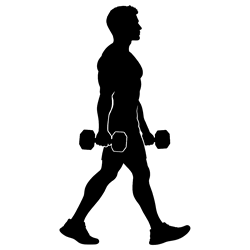
How to do it (Dumbbell)
Pick up a heavy dumbbell in each hand with a flat back, as you would a deadlift.
Stand tall with your shoulders back and down, arms straight at your sides.
Walk with short, quick steps for the set time, keeping your torso upright and your core braced.
Set the dumbbells down with a flat back. If a straight walk is not possible, walk in place or turn around; grip and posture are what count.
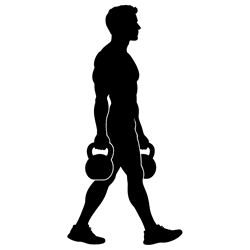
Pick up a kettlebell in each hand with a flat back, as you would a deadlift.
Stand tall with your shoulders back and down, arms straight at your sides.
Walk with short, quick steps for the set time, keeping your torso upright and the kettlebells still.
Set them down with a flat back. One kettlebell only turns this into a suitcase carry that works the obliques hard; switch sides halfway.
Common mistakes
Rushing the pick-up and set-down
The pick-up is a deadlift with the weights at your sides. Squat down, keep your back flat and stand up fully before your first step, and set them down the same way.
Letting your shoulders round forward
Heavy weights pull your shoulders forward and your chest drops. Keep your shoulders back and down and your chest up for every step.
Taking long, slow strides
Long steps make the weights swing into your legs. Short, quick steps keep them still and let you carry more for longer.
Carrying on after your grip slips
Once the handles slide toward your fingertips or your posture slumps, the set is over. Put the weights down with control rather than dropping them.
Sets, reps and progression
How many sets you do and how close to failure you take them depend on your goal and your week, not on the exercise. These guides cover it:
Alternatives that train the same thing
Same movement, a different angle or piece of equipment.