JM Press
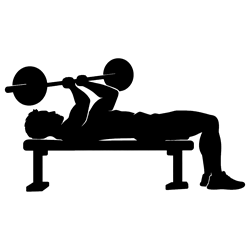
Lying on a flat bench with a slightly narrow grip, you lower the bar toward your chin by bending your elbows and letting them drift forward, then press it back up with your triceps.
- Primary muscles
- Triceps
- Secondary
- Upper chest, Middle chest, Lower chest, Front delts
- Difficulty
- Intermediate
- Logged as
- Weight × reps
Loads from YouTube only when you press play. The video is by an independent creator.
Why do it
Named after powerlifter JM Blakley, it's a hybrid that loads the triceps heavier than skull crushers while keeping more of the work at the elbow than a close-grip bench press. That makes it popular with lifters who want a stronger bench press lockout. The groove takes a few sessions to learn: elbows drifting forward, the bar heading toward your chin, forearms folding onto your biceps. Start light and add weight only once the path feels the same every rep.
How to do it
Lie on a flat bench and hold a barbell above your upper chest with a grip slightly narrower than shoulder-width.
Lower the bar toward your chin by bending your elbows and letting them drift forward, halfway between a close grip bench press and a skull crusher.
Stop when your forearms touch your biceps.
Press the bar back up, driving with the triceps. Start light; the movement feels odd until the groove is familiar.
Common mistakes
Drifting into a press or a skull crusher
Bar to your chest is a press; bar to your forehead with fixed upper arms is an extension. Aim for your chin, let your elbows drift forward, and stop when forearms meet biceps.
Flaring your elbows
Elbows that flare out move the work to your chest and shoulders. Keep them tucked in, roughly in line with your wrists.
Loading up before the groove is set
Adding plates while the path still changes from rep to rep makes each one drift somewhere different. Stay light until every rep finishes in the same spot.
Rebounding off your biceps
Slamming your forearms into your biceps and bouncing up adds momentum. Touch lightly, then press with the triceps.
Sets, reps and progression
How many sets you do and how close to failure you take them depend on your goal and your week, not on the exercise. These guides cover it:
Alternatives that train the same thing
Same movement, a different angle or piece of equipment.