Kettlebell Swing
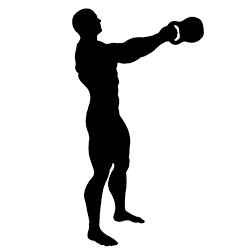
Holding a kettlebell with both hands, you hike it back between your legs and snap your hips forward to swing it to chest height, a fast hinge for glutes and hamstrings.
- Primary muscles
- Glutes, Hamstrings
- Secondary
- Front delts, Quads
- Logged as
- Weight × reps
Loads from YouTube only when you press play. The video is by an independent creator.
Why do it
The swing is an explosive hip hinge: your glutes and hamstrings launch the bell, and your arms only guide it. That makes it a strong choice for conditioning and power, since you can do many reps without the heavy loading of a deadlift. It suits anyone who can already hinge with a flat back; learn the movement with a light bell first. Compared with a pull-through, the load is much lighter but moves fast, so your hips have to produce force quickly and then absorb it on the way down.
How to do it
Stand with your feet slightly wider than shoulder-width, kettlebell on the floor an arm's length in front of you.
Hinge at the hips with a flat back, grip the handle with both hands and hike the kettlebell back between your legs.
Snap your hips forward to swing it up to chest height. The power comes from your hips, not your arms.
Let it swing back down between your legs and hinge into the next rep. If it feels like a front raise, you're lifting with your shoulders instead of your hips.
Common mistakes
Squatting the swing
Bending your knees deeply and dropping your hips straight down makes your thighs do the work. Push your hips back with a soft knee bend, like a hinge.
Lifting the bell with your arms
If it feels like a front raise, your shoulders are lifting. Let the hip snap send the bell up and keep your arms loose, like ropes.
Letting the bell drop below your knees
When the bell swings low behind you, it pulls your back out of position. Hike it high between your thighs, with your forearms close to your inner legs.
Leaning back at the top
Throwing your shoulders back to finish arches your lower back. Stand tall like the top of a deadlift, glutes tight and ribs down.
Sets, reps and progression
How many sets you do and how close to failure you take them depend on your goal and your week, not on the exercise. These guides cover it:
Alternatives that train the same thing
Same movement, a different angle or piece of equipment.