Push Up
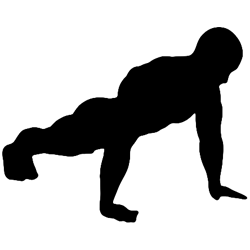
The classic bodyweight press: from a straight-arm plank, you lower your chest to the floor and push back up, training your chest with help from your front delts and triceps.
- Primary muscles
- Upper chest, Middle chest, Lower chest
- Secondary
- Front delts, Triceps
- Difficulty
- Beginner
- Logged as
- Reps
Loads from YouTube only when you press play. The video is by an independent creator.
Why do it
You can do push-ups anywhere, and they scale from beginner to advanced: put your hands on a bench or box to make them easier, raise your feet or add weight to make them harder. Unlike the bench press, your shoulder blades move freely and your core has to hold the plank, so you press and brace in the same rep. If you can't do several clean reps from the floor yet, an incline gives you the same movement at a load you can handle.
How to do it
Place your hands on the floor slightly wider than shoulder-width, shoulders over your wrists, legs extended behind you.
Keep your body in a straight line from head to heels with your core tight.
Lower your chest toward the floor with your elbows at roughly 45 degrees to your torso.
Press back up to straight arms. If your hips sag or lift, do the reps on an incline until you can hold the line.
Common mistakes
Letting your hips sag
A sagging middle shortens the push and puts the strain on your lower back. Squeeze your glutes and brace as if for a plank; if the line still breaks, move to an incline.
Flaring your elbows straight out
Elbows out at shoulder height make for an awkward, shoulder-heavy press. Angle them back toward your hips so your arms and torso form an arrow, not a T.
Cutting the range short
Half reps near the top skip the part where your chest works hardest. Lower until your chest is close to the floor, and use an incline if you can't get there yet.
Leading with your head
Dropping your chin toward the floor makes reps look deeper than they are. Keep your neck in line with your back and let your chest arrive first.
Sets, reps and progression
How many sets you do and how close to failure you take them depend on your goal and your week, not on the exercise. These guides cover it:
Alternatives that train the same thing
Same movement, a different angle or piece of equipment.