Wall Push Up
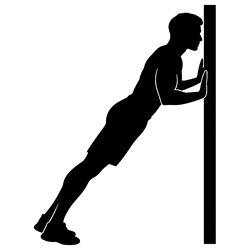
The easiest push-up: standing at arm's length from a wall, you lower your chest toward it and push back, training your chest, front delts and triceps with very little load.
- Primary muscles
- Upper chest, Middle chest, Lower chest
- Secondary
- Front delts, Triceps
- Difficulty
- Beginner
- Logged as
- Reps
Loads from YouTube only when you press play. The video is by an independent creator.
Why do it
Wall push-ups suit complete beginners, people returning after a long break, and anyone who can't yet do push-ups against a bench. Because you're nearly upright, only a small part of your body weight goes through your hands, and you adjust the difficulty just by walking your feet back. It teaches the same body line and elbow path as a floor push-up, so treat it as the first rung: once high-rep sets feel easy, move to an incline on a bench or counter.
How to do it
Stand facing a wall about an arm's length away and place your hands on it at shoulder height, shoulder-width apart.
Keep your body in a straight line and bend your elbows to bring your chest toward the wall.
Stop when your face is close to the wall.
Push back to the start. Step your feet further from the wall to make it harder, and move on to incline push ups when you can do 20 easily.
Common mistakes
Standing too close to the wall
With your feet near the wall there's almost nothing to push, and the rep becomes a lean. Step back until your chest and arms feel the work while you can still hold a straight line.
Bending at the hips
Pushing your hips back as you lower shortens the movement and lets your arms do less. Squeeze your glutes and move as one plank from head to heels.
Placing your hands too high
Hands above your head turn it into an awkward overhead push. Keep them at shoulder height and about as wide as your shoulders.
Staying on the wall too long
It's a starting point, not a destination. When high-rep sets get easy, move to a lower surface so your chest keeps getting a real challenge.
Sets, reps and progression
How many sets you do and how close to failure you take them depend on your goal and your week, not on the exercise. These guides cover it:
Alternatives that train the same thing
Same movement, a different angle or piece of equipment.