Arm Bike
A hand-cranked ergometer you turn with both arms in circles, giving you cardio from your shoulders and arms while your legs rest.
- Primary muscles
- Front delts, Triceps
- Secondary
- Biceps, Upper back, Side delts
- Logged as
- Session: time, plus what the machine shows, such as distance and calories
Loads from YouTube only when you press play. The video is by an independent creator.
Why do it
The arm bike is cardio for when your legs need a break, whether after a hard leg day, during a lower-body injury or from a seated setup, and it's a solid warm-up for upper-body sessions. Your shoulders and arms tire long before your heart and lungs would on a leg-driven machine, so expect lower levels and shorter blocks. Many arm bikes also turn backwards, which puts more of the pull on your upper back.
How to do it
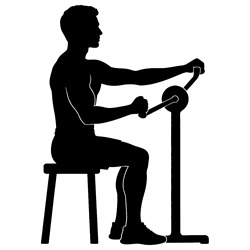
Sit or stand facing the arm bike with the crank at shoulder height, so your arms are almost straight at the far point.
Start on a low level and turn the handles in smooth circles, pushing away and pulling back with both arms.
Keep your shoulders down and your torso still; your arms and shoulders do the work, not a rocking body.
Lower the level for the last minute. Log level and cadence as they change and copy distance and watts from the display at the end.
Common mistakes
Crank at the wrong height
The crank should sit at shoulder height so your arms are almost straight at the far point. Too high and your shoulders shrug up, too low and you hunch forward.
Rocking the torso
Swinging your body into each turn hides how tired your arms are. Sit tall, keep your shoulders down and let the arms move.
Starting on a high level
Arms fatigue quickly. Start low, find a pace you can hold and raise the level only once it feels steady.
Sets, reps and progression
How many sets you do and how close to failure you take them depend on your goal and your week, not on the exercise. These guides cover it:
Alternatives that train the same thing
Same movement, a different angle or piece of equipment.