Battle Ropes
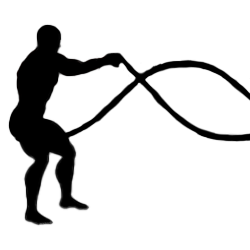
A conditioning drill where you hold one end of a heavy anchored rope in each hand and whip it into waves or circles for time, working your shoulders, core and arms.
- Primary muscles
- Front delts, Abs, Obliques
- Secondary
- Biceps, Triceps, Quads, Glutes
- Logged as
- Time
Loads from YouTube only when you press play. The video is by an independent creator.
Why do it
Ropes are low-impact and easy to learn, which makes them useful for conditioning when running or jumping isn't an option. Alternating waves are the easiest to keep going, double waves with both arms together are more demanding, and circles change how the shoulders work. Short, hard intervals suit them well, since your grip and shoulders fade fast on long ones.
How to do it
Stand with your feet shoulder-width apart, knees slightly bent, one rope end in each hand and your elbows soft.
Face the anchor and step back until the ropes have some slack but not too much.
Pick a pattern: alternating waves, double waves with both arms together, or small circles.
Drive the rhythm from your legs and hips rather than just your arms, and keep it going for the set time. Your grip usually gives out before your shoulders do.
Common mistakes
Standing tall with straight legs
Locked knees leave your arms doing everything and the waves die quickly. Sit into a slight squat and drive the rhythm from your legs and hips.
Ropes too slack or too tight
Too much slack and the waves stall; pulled taut, they won't travel. Step back until there's just a little slack, as the steps describe.
Squeezing the rope too hard
A death grip burns out your forearms before your shoulders. Hold just firmly enough to control the rope and keep your elbows soft.
Making small, lazy waves
Tiny waves look busy but barely load you. Use full, powerful arm movements so each wave travels all the way to the anchor.
Sets, reps and progression
How many sets you do and how close to failure you take them depend on your goal and your week, not on the exercise. These guides cover it:
Alternatives that train the same thing
Same movement, a different angle or piece of equipment.