Copenhagen Plank
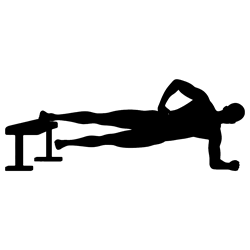
A side plank with your top leg resting on a bench: you hold your hips up off the floor with your inner thigh, while your obliques and abs keep your body level.
- Primary muscles
- Adductors
- Secondary
- Obliques, Abs
- Difficulty
- Intermediate
- Logged as
- Time
Loads from YouTube only when you press play. The video is by an independent creator.
Why do it
It's one of the few ways to train the adductors with only a bench and your bodyweight, and it's popular with people who play field and court sports. Unlike a machine adduction, you hold a position instead of moving a weight, and your obliques work hard to keep your body straight. Start with the knee on the bench, which shortens the lever, and move out to the foot once you can hold a clean line for the whole set.
How to do it
Lie on your side with your forearm on the floor under your shoulder and your top leg resting on a bench, the bottom leg underneath it.
Lift your hips and bottom leg off the floor so your body forms a straight line, supported by the forearm and the inside of the top foot or knee.
Hold for the set time, squeezing the inner thigh of the top leg.
Lower under control and switch sides. Rest the knee instead of the foot on the bench to make it easier.
Common mistakes
Letting your hips sag
Once your hips drop toward the floor, the inner thigh stops holding you up. Keep a straight line from head to feet, and end the set when you can't.
Starting with the foot on the bench
Supporting yourself on the foot makes a long, hard lever. Begin with the knee on the bench and move to the foot once the shorter version feels steady.
Leaving the bottom leg on the floor
If the bottom foot stays down, that leg takes some of your weight. Lift it up under the bench so the top leg has to carry you.
Rolling forward or back
Keep your shoulders stacked and your chest facing sideways. Rolling toward the floor shifts the load from your inner thigh onto your supporting shoulder.
Sets, reps and progression
How many sets you do and how close to failure you take them depend on your goal and your week, not on the exercise. These guides cover it:
Alternatives that train the same thing
Same movement, a different angle or piece of equipment.